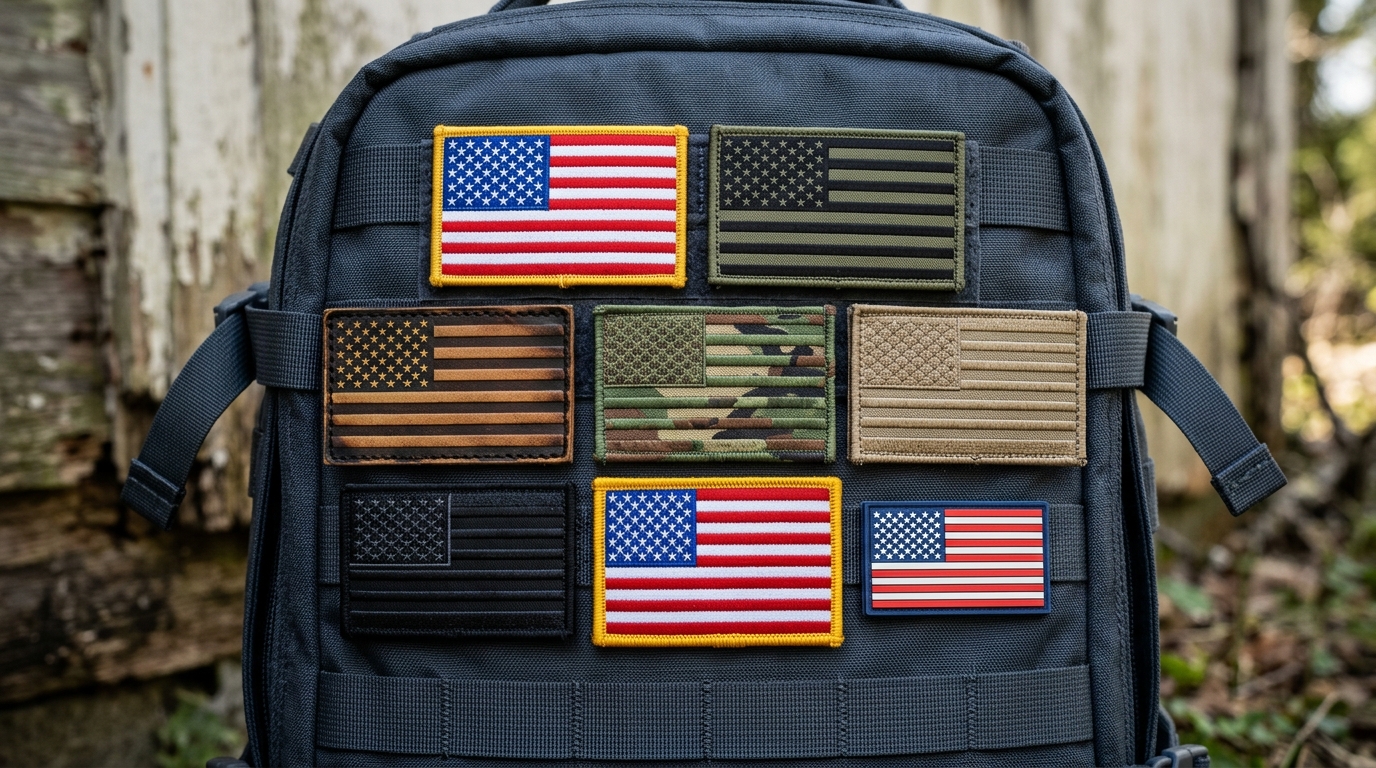
American flag patches have a place in everything from military-inspired uniforms and tactical equipment to everyday jackets, hats, and backpacks. Their familiar stars and stripes make them easy to recognize, while different materials, colors, and attachment styles give buyers plenty of choices. Some people prefer a traditional embroidered American flag patch, while others look for subdued tactical designs or removable patches with Velcro backing.
For clothing brands, uniform suppliers, retailers, and organizations, choosing the right US flag patches involves more than finding a design that looks good. Size, stitching, fabric, backing, and manufacturing quality all affect how the finished patch looks and performs. Buyers who need larger quantities may also have questions about wholesale pricing, minimum order requirements, production times, and custom design options.
The market offers plenty of choices, including custom US flag patches, embroidered American flag patches, sew on designs, iron on patches, and tactical versions. Each type serves a different purpose. A patch made for a baseball cap, for example, may need different dimensions and construction from one intended for a uniform sleeve or tactical backpack.
Knowing what to look for before ordering can save time, prevent sizing problems, and help you choose a patch that suits the garment or equipment. Whether you are buying a few pieces or arranging a large commercial order, the right combination of design and construction makes a noticeable difference.
Why American Flag Patches Are a Popular Choice for Clothing and Gear
The American flag is a familiar symbol that people recognize across different settings. Adding it to clothing or equipment creates a clear visual detail that can represent national pride, personal interests, or a connection to American heritage.
American flag patches are commonly found on jackets, uniforms, baseball caps, outdoor clothing, tactical bags, and backpacks. Their popularity comes partly from their versatility. A traditional embroidered design can suit a classic denim jacket, while a subdued version may look more appropriate on tactical equipment.
Businesses also use flag patches across different product ranges. Clothing manufacturers may add them to sleeves or chest panels, while uniform suppliers often stock standard sizes for their customers. Retailers can offer several styles to appeal to people looking for patriotic accessories.
Another reason buyers continue to choose these patches is the range of available finishes. Full-color flags provide a traditional appearance, while black and gray designs offer a darker look. Distressed versions, reverse flag patches, and subdued tactical styles give customers more freedom when selecting a design.
The intended use should always guide the purchase. A decorative patch for a casual jacket does not necessarily need the same backing or construction as one that will be attached to frequently used outdoor equipment.
Custom US Flag Patches Made to Match Your Requirements
Not every garment or piece of equipment has room for a standard-sized flag patch. This is where custom US flag patches become useful. They allow buyers to choose dimensions, materials, colors, borders, and backing options that match a particular application.
For example, a clothing brand may need a small American flag patch for the sleeve of a jacket. A tactical equipment supplier might require a wider design that fits an existing hook and loop panel. A hat manufacturer may need a compact patch that sits neatly on a curved front panel.
Custom American flag patches can also be produced in different shapes and finishes. Some customers want a traditional rectangular flag, while others prefer rounded corners or specially finished edges. The final design should be agreed upon before production so the manufacturer can prepare the correct specifications.
When requesting a custom order, provide the supplier with clear information about the following:
Patch size: Share the exact width and height required.
Design: Supply the preferred flag artwork or a clear reference image.
Fabric: Discuss suitable base materials for the intended use.
Embroidery: Decide how much of the design should be covered with stitching.
Border: Select an edge finish that suits the garment.
Backing: Choose sew on, iron on, or hook and loop attachment.
Quantity: Confirm how many patches are required.
Delivery: Ask about production time and shipping arrangements.
Providing these details early makes communication easier and reduces the chance of receiving a product that does not match the original requirement.
Embroidered American Flag Patches With Clean Stitching
Embroidered American flag patches remain a popular choice because of their textured finish and traditional appearance. Instead of printing the design onto a flat surface, embroidery uses colored thread to form the stars, stripes, and other details.
The raised stitching gives the patch a noticeable texture that works well on jackets, uniforms, caps, backpacks, and tactical clothing. It also gives manufacturers room to create different finishes depending on the thread, fabric, and stitch pattern.
Good embroidery should look neat from both a distance and up close. The stars need to be recognizable, the stripes should be properly arranged, and the edges should have a clean finish. Loose threads and uneven stitching can make even a well-designed patch look poorly made.
Fabric selection also matters. The base material should support the embroidery without becoming distorted during production. The thread should be suitable for the intended application, particularly when the patch will be attached to clothing that receives regular use.
For businesses ordering embroidered American flag patches in bulk, consistency is just as important as the appearance of an individual piece. Each patch should follow the approved dimensions, color arrangement, and stitching pattern.
Requesting a sample before approving a large order is a sensible way to check these details. It gives buyers an opportunity to examine the actual construction rather than relying entirely on a digital design.
Custom Embroidered US Flag Patches for Clothing Brands and Uniform Suppliers
Custom embroidered US flag patches are useful for businesses that need a particular size, design, or finish rather than an off-the-shelf product. Clothing brands, uniform distributors, promotional merchandise companies, and tactical equipment suppliers may all have different production requirements.
A uniform supplier might need hundreds of matching patches for a particular clothing range. An apparel brand may want a smaller design with a specific border and thread color. A promotional merchandise business may require several sizes for different products.
The process normally begins with a design reference and a discussion about the finished dimensions. The manufacturer can then recommend a suitable fabric, embroidery method, and backing option.
Artwork approval is an important part of the process. Before production begins, check the placement of the stars, the arrangement of the stripes, the proportions, and the selected colors. Even small design differences can become noticeable when patches are produced in large quantities.
Businesses should also keep a copy of the approved artwork and specifications. This makes future orders easier because the manufacturer can refer to the same requirements when producing replacement stock.
If the patches are intended for clothing that will be washed regularly, discuss the appropriate backing and care instructions before finalizing the order.
US Flag Patches With Velcro Backing for Easy Replacement
US flag patches with Velcro backing are particularly useful for tactical clothing and equipment that already has compatible hook and loop panels. They can be attached, removed, and replaced without permanently stitching the patch onto the garment.
This makes them a practical option for tactical backpacks, plate carriers, jackets, caps, and other equipment. Users can keep different patches available and change them according to their requirements.
A hook and loop system normally has two surfaces. The patch carries the hook material, while the garment or equipment has a compatible loop panel. When pressed together, the two surfaces hold the patch in place.
Before ordering, check whether the equipment already has a loop panel. Some patches come with hook backing attached, while others may include additional attachment pieces.
The quality of the backing should not be overlooked. A patch may have excellent embroidery, but weak attachment material can affect its usefulness. Check the stitching around the backing and make sure the patch is the correct size for the available panel.
These patches are also available in different colors and finishes. Full-color designs are suitable for people who want the traditional flag appearance, while subdued versions are often selected for tactical-inspired clothing and equipment.
Tactical American Flag Patches for Backpacks Uniforms and Outdoor Gear
Tactical American flag patches have become a familiar addition to outdoor clothing and military-inspired equipment. They are available in several finishes, including full-color, black and gray, subdued, and distressed designs.
Their practical appeal comes from the combination of recognizable flag artwork and construction suited to compatible tactical gear. Many versions use hook and loop backing, allowing the patch to be moved between backpacks, jackets, and other equipment.
Subdued American flag patches are especially popular among buyers who prefer a less noticeable design. Rather than using the traditional bright red, white, and blue colors, these patches use darker shades that blend more easily with certain clothing and equipment.
Black and gray American flag patches offer another option. They have a simple appearance and can complement dark jackets, tactical caps, and bags.
When selecting a tactical patch, consider where it will be used. Outdoor equipment may experience rain, sunlight, friction, and frequent handling. The fabric, thread, border, and attachment system should be suitable for those conditions.
It is also worth checking the size of the available attachment panel. A patch should fit properly without covering nearby pockets, straps, or equipment features.
For professional uniforms, confirm the permitted design and placement with the relevant organization before ordering or wearing a particular tactical flag patch.
American Flag Patches for Uniforms and Professional Clothing
American flag patches for uniforms are used in different professional and organizational settings. They may appear on military-style clothing, security uniforms, public service apparel, and certain workwear collections.
The upper sleeve is a common placement because it provides a visible area for the flag design. US flag shoulder patches are therefore widely available in sizes intended for uniform sleeves.
However, uniform requirements can vary considerably. Some organizations specify the exact patch dimensions, position, orientation, and attachment method. Others may have their own approved designs and color requirements.
For this reason, buyers should check the applicable clothing guidelines before purchasing patches for professional use.
Uniform suppliers also need to think about consistency. If several employees or departments require the same patch, ordering identical designs helps maintain a neat and coordinated appearance.
A good supplier should be able to provide the same approved specifications across repeat orders. This is particularly useful for organizations that need replacement patches throughout the year.
For frequently worn uniforms, consider whether the patch will be sewn on permanently or attached through a removable backing system. The best choice depends on the garment and the organization's requirements.
USA Flag Patches Wholesale for Retailers and Commercial Buyers
USA flag patches wholesale orders are suitable for businesses that need more than a few individual pieces. Retailers, uniform distributors, clothing brands, promotional merchandise suppliers, and equipment stores may purchase larger quantities to maintain stock or fulfill customer orders.
Wholesale purchasing can make it easier to manage inventory and obtain consistent products. Depending on the supplier, larger quantities may also offer a lower price per patch than small individual orders.
Before selecting a wholesale supplier, ask about minimum order quantities, production capacity, available sizes, and customization options. Some suppliers mainly offer ready-made American flag patches, while others manufacture designs according to customer specifications.
It is worth comparing the complete offer rather than choosing a supplier based on price alone. Stitching quality, backing materials, packaging, delivery arrangements, and communication all matter.
Businesses should also ask whether samples are available. A sample gives buyers a chance to inspect the patch before approving a larger purchase.
For regular wholesale orders, keeping approved specifications on file can help avoid differences between production batches. This is especially useful for retailers who want the same design available throughout the year.
US Flag Patches Bulk Orders and What Affects the Price
US flag patches bulk orders can be a practical choice for organizations and businesses that need matching products in larger quantities. However, the final price depends on more than the number of pieces being ordered.
Patch dimensions are one of the main cost factors. Larger designs generally use more fabric and thread. Detailed embroidery can also require additional production time, especially when the design includes small stars or closely arranged details.
The backing option can affect the price as well. Sew on backing, heat-activated adhesive, and hook and loop materials have different production requirements.
Quantity also plays a role. Manufacturers may offer different pricing levels depending on the order size. Buyers should ask for quotations at several quantities if they are unsure how many pieces to purchase.
Other expenses may include sample preparation, custom artwork adjustments, packaging, shipping, and applicable import charges.
A wholesale quotation should clearly explain what is included in the price. Before confirming an order, ask the supplier to provide details about:
Unit pricing at different order quantities.
Patch dimensions and construction.
Embroidery and material specifications.
Backing options and additional costs.
Sample approval arrangements.
Estimated production time.
Packaging and shipping charges.
Payment terms and reorder conditions.
Comparing these details helps businesses understand the actual cost of an order and avoid unexpected expenses.
Choosing an American Flag Patches Manufacturer You Can Rely On
Finding the right American flag patches manufacturer is important when product quality and consistent supply matter. A suitable manufacturer should understand embroidery, material selection, edge finishing, backing options, and the requirements of different applications.
Start by checking the manufacturer's product samples. Look closely at the stars, stripes, stitching, border, and fabric. The finished patch should match the approved artwork and have no obvious production defects.
It is also important to ask about customization. Not every manufacturer offers the same range of sizes, materials, shapes, or attachment methods. If your project requires custom embroidered US flag patches, confirm that the supplier can produce the requested design.
Communication should be clear from the beginning. The manufacturer should be able to explain its minimum order requirements, sample process, estimated production time, and delivery arrangements.
For larger orders, ask how quality checks are handled. Find out whether the manufacturer checks dimensions, stitching, backing, and color consistency before packing the products.
Repeat-order capability is another useful consideration. Businesses often need the same patch again after selling through their existing stock. Working with a supplier that keeps approved specifications can make future orders more straightforward.
American Flag Patches Made in USA and What Buyers Should Check
Some customers specifically look for American flag patches made in USA. They may prefer domestic production, want to support American manufacturers, or need products that meet particular purchasing requirements.
It is important to understand that a patch displaying the American flag is not automatically manufactured in the United States. The design and the country of manufacture are two separate things.
Before placing an order, ask the supplier where the patch is actually produced. You can also ask where the embroidery takes place and whether the fabric, thread, and backing materials are sourced domestically.
For businesses purchasing patches for resale, accurate country-of-origin information is especially important. Product descriptions should not claim domestic manufacturing unless the supplier can support that statement.
Buyers comparing American-made products should also examine the construction and specifications. Domestic origin alone does not guarantee that a patch has the right dimensions, stitching, or backing for a particular application.
Clear information from the manufacturer makes it easier to choose a product that meets both purchasing and quality requirements.
US Flag Patches for Clothing That Look Right on Every Garment
US flag patches for clothing are available for a wide range of garments, including denim jackets, shirts, hoodies, workwear, and outdoor apparel.
The most suitable patch depends on the fabric and the area where it will be attached. A heavy embroidered patch may work well on a denim jacket, but a smaller design may be more appropriate for lightweight clothing.
Sleeves and shoulders are common locations, although some clothing designs use patches on the chest, upper back, or decorative panels.
Color is another consideration. Full-color American flag patches stand out against neutral fabrics such as black, navy, gray, and khaki. Subdued designs can create a more understated appearance.
Before attaching a patch, check whether the garment can support its weight and backing. Stretch fabrics may need additional care because repeated movement can affect the attachment.
For clothing manufacturers, it is useful to test a patch on the actual garment material before moving into full production. This helps identify any issues with placement, stitching, or adhesive compatibility.
American Flag Patches for Hats and Baseball Caps
American flag patches for hats are a popular option for retailers, clothing brands, outdoor enthusiasts, and people who enjoy patriotic accessories.
They are commonly used on baseball caps, trucker hats, tactical caps, and other styles of headwear. Because the front panel of a hat is usually smaller and curved, the patch needs to be sized carefully.
A patch that looks suitable on a jacket may be too large for a cap. Measuring the available area before ordering helps prevent this problem.
Embroidered patches are a common choice because their raised stitching gives the flag a defined appearance. Smaller designs are often easier to fit on curved panels without making the hat look crowded.
Attachment options depend on the hat material and construction. Sew on patches provide a permanent finish, while some caps include loop panels for removable Velcro-backed patches. Iron on versions should only be used when the fabric and manufacturer's instructions allow heat application.
For businesses producing hats in several colors, matching the patch dimensions and stitching across the collection can help maintain a consistent appearance.
American Flag Sew On Patches for a Secure Finish
American flag sew on patches are a straightforward choice when the patch needs to remain attached to a garment or accessory. They are commonly used on jackets, uniforms, backpacks, hats, and workwear.
The patch is attached directly to the fabric using thread, which makes this option suitable for applications where regular removal is not necessary.
A neat finish starts with proper positioning. Place the patch where it is intended to sit, check that it is straight, and secure it before beginning the stitching.
Use thread that matches the patch border or garment, depending on the desired appearance. The stitching should hold the edges firmly without pulling or bunching the fabric.
A sewing machine can be useful for larger patches and heavier materials. Smaller designs may be easier to attach by hand.
One advantage of sew on patches is that they do not rely on heat-sensitive adhesive. They can be a practical choice for garments that are washed regularly, although the final performance depends on the thread, fabric, stitching, and care instructions.
When buying sew on American flag patches, look for a properly finished border with enough space for secure attachment.
American Flag Iron On Patches for Simple Clothing Projects
American flag iron on patches offer a convenient option for people who want to add a flag design to compatible clothing without sewing.
These patches usually have a heat-activated adhesive on the back. When applied according to the manufacturer's instructions, the adhesive bonds with the fabric and holds the patch in place.
They are often used on jackets, shirts, bags, and other suitable garments. However, the fabric must be able to tolerate the required heat.
Delicate materials, heat-sensitive synthetics, and certain coated fabrics may not be suitable for iron on application. Always check the garment care label and patch instructions before starting.
The application method also matters. The correct temperature, pressure, and application time help create a proper bond. Applying too much heat can damage the garment, while insufficient heat may prevent the adhesive from attaching correctly.
For clothing that receives frequent washing or heavy use, additional stitching may be worth considering if the patch manufacturer allows it.
Iron on backing is convenient, but it should not be treated as a suitable option for every type of fabric.
Personalized American Flag Patches for Individual Designs
Personalized American flag patches give buyers more control over the finished design. They are useful for individual clothing projects, clubs, merchandise collections, and businesses that need a particular patch style.
Personalization may involve changing the dimensions, border, thread colors, or backing. Some customers want a traditional flag with a specific size, while others prefer subdued colors or a particular edge finish.
Before ordering, decide where the patch will be used. A design for a hat may need different proportions from one intended for a backpack or jacket.
Businesses should provide clear artwork and measurements to the manufacturer. If the design is being produced in large quantities, request a proof or sample before approving production.
It is also worth confirming whether the supplier can reproduce the same design for future orders. This is important for brands and retailers that want their products to remain consistent.
A personalized patch should still be practical for its intended use. Choosing the right material and backing is just as important as selecting the appearance.
American Flag Morale Patches for Tactical and Casual Wear
American flag morale patches are often associated with tactical clothing, outdoor equipment, and military-inspired fashion. They combine flag designs with different finishes and styles, giving buyers more options than a traditional embroidered patch.
Some designs use full-color stars and stripes, while others feature black and gray thread, subdued shades, or distressed details.
Hook and loop backing is common on morale patches because it makes them easy to attach and remove from compatible equipment. They are frequently used on tactical backpacks, caps, jackets, and bags with loop panels.
For buyers who collect patches, different finishes can add variety to a collection. A traditional flag can sit alongside a subdued version or a monochrome design.
Construction should still be considered before purchasing. Check the stitching, border, backing, and dimensions to make sure the patch is suitable for the equipment.
For uniforms and professional applications, follow the relevant organization's rules about morale patches and permitted designs.
Understanding the Difference Between Embroidered Woven and Printed Patches
Not all American flag patches are made in the same way. Embroidered, woven, and printed designs each have different characteristics, and understanding those differences can help buyers select the right product.
Embroidered patches use thread stitched onto a fabric base. They have a raised texture and are a popular choice for traditional American flag designs. Their appearance works well on jackets, uniforms, hats, and bags.
Woven patches use finer threads to produce a flatter surface. This construction can be useful when the design contains small details that need to remain clear.
Printed patches have the design applied to the surface of the material. They can reproduce certain details without the raised texture of embroidery and may suit particular clothing or promotional applications.
The best choice depends on the desired appearance, level of detail, budget, and intended use.
For a traditional flag patch with visible stitching, embroidery is often a natural choice. For smaller details, woven construction may be worth considering. Printed designs may work when a flatter finish is preferred.
Ask the manufacturer for samples if you are unsure which method will suit your project.
Finding the Right Patch Backing for Your Clothing and Equipment
Backing is one of the most important decisions when purchasing American flag patches. Even a well-made patch may not be suitable if its attachment method does not match the garment.
Sew on backing is intended for permanent attachment. It is a good option for uniforms, jackets, and other garments where the patch will remain in place.
Iron on backing uses heat-activated adhesive. It can be convenient for compatible fabrics, provided the garment can tolerate the required application temperature.
Velcro backing allows a patch to be removed and replaced. It is especially useful for tactical equipment, caps, and bags with compatible loop panels.
Adhesive backing may be available for temporary decorative applications. Its suitability depends on the surface and the adhesive used.
Before choosing, think about how frequently the patch will be handled, whether the garment will be washed, and whether the design needs to be removable.
For wholesale buyers, confirming the backing specification before production is particularly important. Different backing materials can affect the price, production process, and finished patch dimensions.
How to Prepare a Bulk American Flag Patch Order
A little preparation can make a large patch order easier to manage. Before contacting a manufacturer, decide what you need and prepare the details in one place.
Start with the design. Make sure the flag artwork, orientation, colors, and proportions are correct. If you already have a reference image, share it with the supplier.
Next, decide the dimensions. Measure the available area on the garment or equipment instead of estimating the size.
Choose the construction method and backing. Embroidery may be suitable for a traditional appearance, while hook and loop backing may be better for removable tactical patches.
After that, work out the quantity. If you are ordering for a retail business, consider your expected stock requirements. For uniform suppliers, use the number of garments or replacements needed to estimate the order size.
Ask the manufacturer for a quotation and confirm whether a sample is available. Review the sample carefully before approving the complete production run.
Finally, confirm the delivery schedule, packaging, payment terms, and shipping costs. Keep a record of the approved design and specifications so that future orders can follow the same requirements.
What to Look for Before Buying American Flag Patches Online
Buying American flag patches online gives customers access to different designs and suppliers. However, product photographs do not always show every detail, so it is important to read the specifications before purchasing.
Start by checking the patch dimensions. Make sure the size is suitable for the intended location, whether that is a sleeve, jacket panel, hat, or backpack.
Next, check the construction. Product descriptions should explain whether the patch is embroidered, woven, or printed.
Pay close attention to the backing. A listing may show a patch without making it clear whether it is sew on, iron on, or Velcro-backed. Confirm this before ordering.
Product images can also provide useful information. Look for close-up photographs showing the stitching, border, and rear side of the patch.
If you are purchasing in larger quantities, contact the supplier to ask about wholesale pricing and sample availability. It is better to clarify order requirements before making payment.
For customers looking for American flag patches made in USA, ask for confirmation of the actual manufacturing location. Do not assume that the flag design indicates domestic production.
Taking these steps can help you choose a patch that matches the product description and your intended application.
Conclusion
American flag patches are available in a wide range of designs for uniforms, tactical equipment, hats, jackets, backpacks, and everyday clothing. From traditional embroidered American flag patches to subdued tactical styles, there are options for individual customers, clothing brands, retailers, and commercial buyers.
The right choice depends on how the patch will be used. American flag sew on patches are suitable for permanent attachment, while iron on designs offer a convenient option for compatible fabrics. US flag patches with Velcro backing are particularly useful for tactical equipment and clothing with hook and loop panels.
Businesses looking for custom US flag patches should pay attention to dimensions, embroidery quality, backing materials, and sample approval before placing an order. Those purchasing USA flag patches wholesale or arranging US flag patches bulk orders should also compare pricing, minimum quantities, production capacity, and delivery arrangements.
If American flag patches made in USA are a priority, always confirm the manufacturing location with the supplier. Clear product information and accurate specifications help avoid misunderstandings.
Whether you need a few personalized American flag patches or a large quantity for commercial use, choosing the right design and construction will help you get a product that looks appropriate and works well for its intended purpose.
Discussion & Feedback 0
Write a CommentNo comments yet
Have a question or feedback regarding this topic? Be the first to share your thoughts below!
Leave a Reply
Your email address will not be published. Required fields are marked *