In motorcycle culture, a rider’s leather or denim vest—universally referred to within the community as a "cut," "kutte," or "colors"—is far more than protective highway outerwear. It is a sacred visual record of brotherhood, territorial allegiance, road mileage, fallen comrades, and personal honor. At the heart of this sacred tradition are custom biker patches.
However, unlike mainstream fashion where patches are sewn on randomly for aesthetics, the motorcycle world is governed by strict, unwritten bylaws, historical conventions, and regional confederation protocols. Designing or wearing the wrong patch combination—such as inadvertently claiming a contested state territory rocker, sporting unauthorized "MC" lettering cubes, or misplacing officer tags—can provoke intense confrontations with dominant motorcycle clubs.
Whether you are establishing a new family Riding Club (RC), founding a veteran motorcycle association, creating memorial tributes for a fallen brother, or tailoring patches for weekend cruiser enthusiasts, this exhaustive manual from Patched Custom details the visual hierarchy, rocker etiquette, officer patch designations, industrial leather sewing specifications, and highway durability standards required for genuine biker patches.
The Historical Evolution of Biker "Colors" & Vest Traditions
The tradition of wearing embroidered back emblems on leather vests traces its roots to post-World War II America. Returning combat veterans, particularly army air corps mechanics and bomber crews who had custom-painted squadron insignias on their leather A-2 jackets, sought camaraderie and adrenaline by forming motorcycle clubs across California and the Midwest.
In 1947, following the infamous Hollister motorcycle rally, the American Motorcyclist Association (AMA) famously claimed that 99% of motorcycle riders were law-abiding citizens, leaving the remaining 1% as outlaws. This gave birth to the iconic diamond-shaped "1%er" patch, cementing back patches as the definitive currency of motorcycle club sovereignty.
Anatomy of the Biker Back: 1-Piece vs. 2-Piece vs. 3-Piece Configurations
The physical structure of back patches communicates a club’s organizational tier and relationship with the broader motorcycle community:
Rocker Etiquette & Territory Rules: Why the Bottom Rocker Matters
Among all elements of motorcycle vest heraldry, the Bottom Rocker is by far the most strictly policed.
Top Rocker (Club Name)
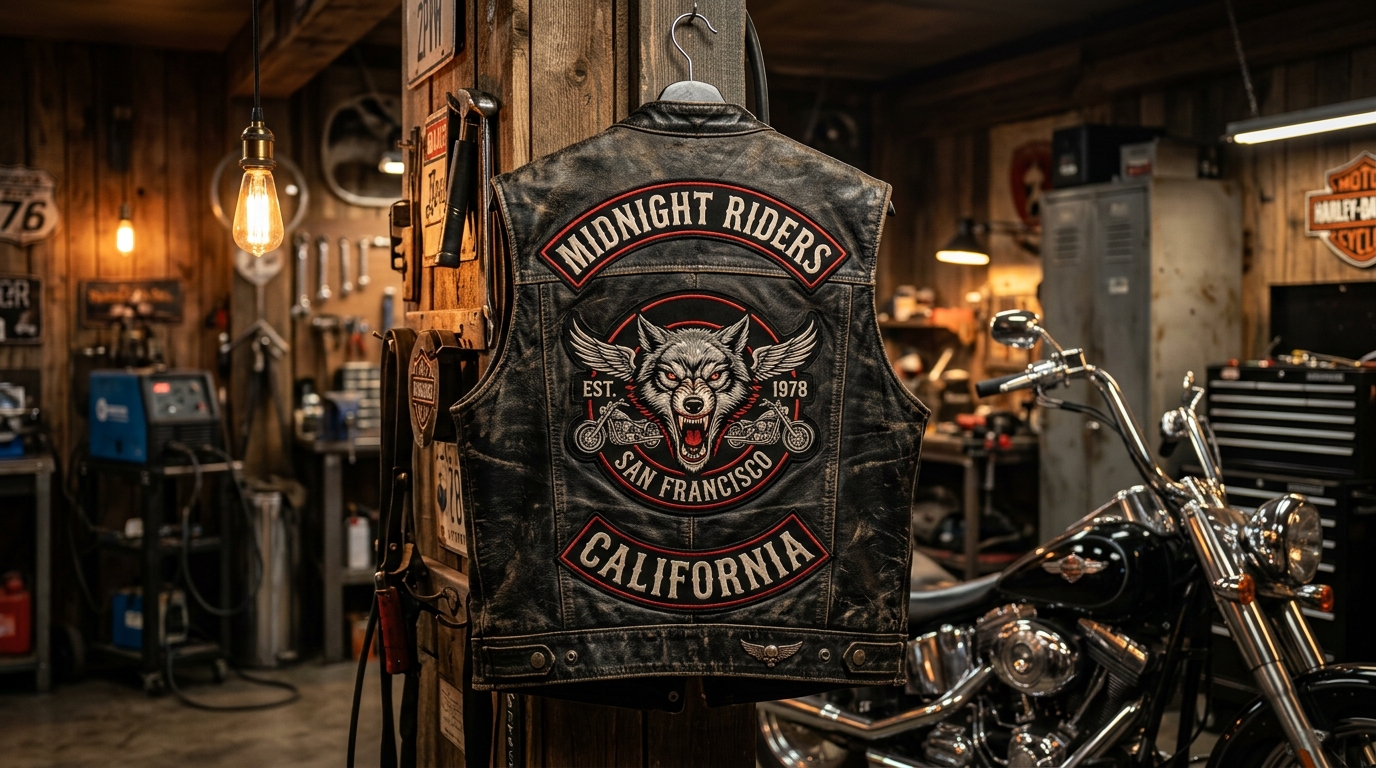
The top rocker forms an upward-arching banner sewn across the shoulder blades, proclaiming the club’s official name. Its radius is mathematically drafted to follow the ergonomic taper of human shoulder musculature across vest sizes Medium through 5XL.
Center Crest (Club Mascot / Insignia)
The centerpiece is the club’s sacred visual crest, usually measuring 10 to 14 inches tall. It is almost always crafted with 100% heavy thread embroidery on heavy black poly-cotton twill to withstand engine heat and oil grime.
Bottom Rocker (The Territorial Claim)
The bottom rocker is an inverted arched banner sewn beneath the center crest. In traditional motorcycle hierarchy, placing a city, county, or state name on a bottom rocker declares that the club claims territorial sovereignty over that area. Wearing an unauthorized bottom rocker claiming a state (e.g., "CALIFORNIA", "TEXAS", "NEW YORK") is interpreted by dominant traditional clubs as an act of defiance.
If you are establishing an independent riding group or hobbyist cruiser chapter, never use a geographic state or city on your bottom rocker. Instead, use non-territorial wording such as "NOMAD", "WORLDWIDE", or the motorcycle model you ride (e.g., "CRUISERS"), or incorporate your city name safely inside a unified 1-piece circular back patch.
Front Vest Layout: Officer Tags, Road Names & Rank Insignia
While the back of the cut displays club loyalty, the front chest panels communicate leadership rank, chapter standing, and personal road history:
Industrial Manufacturing Specs for Heavy Biker Patches
Riding at 80 miles per hour through driving thunderstorms, searing summer heat, gravel spray, and oily exhaust mist places punishing mechanical strain on patches. Standard craft-store iron-on patches will peel, curl, or disintegrate within weeks.
- 20oz Heavyweight Poly-Cotton Foundation Twill: High-tensile backing that resists stretching, humidity sagging, and curling under heavy vibration.
- 3-Thread Merrowed Overlock Border with Tucked Tails: Dense Merrow border cord wrapping completely around the edge. We leave a 3-inch heat-sealed thread tail tucked cleanly inside to ensure wind turbulence cannot unravel the edge.
- Trilobal Polyester 40wt Spun Threads: High-tensile UV-stabilized threads impervious to gasoline splatters, bug acid, road salt, and sunlight fading.
- High-Impact PVC Plastic Stiffener Backing: Biker patches require substantial structural rigidity so 12-to-14-inch back rockers remain flat and wrinkle-free when sewn across heavy leather jacket seams.
How to Sew Custom Patches Onto Heavy Cowhide Leather Vests
Warning: Never attempt to iron a patch onto a leather vest! The 350°F heat will dry out natural leather, scorch the finish, and shrink the hide permanently. Custom biker patches must always be sewn on using specialized leatherworking techniques:
- Positioning with Temporary Leather Basting Tape: Secure rockers and crests using double-sided leather basting tape or painter’s masking tape. Never use sewing pins, as pins puncture permanent holes into natural leather.
- Thread Selection: Use heavy bonded nylon thread (Size #69 / Tex 70) or bonded polyester thread in black or matching border color. Standard cotton thread rots quickly when wet.
- Needle Type: On industrial walking-foot sewing machines, install a sharp Leather Point (Wedge/Tri-Point) needle size 18/110 or 20/125. The triangular wedge blade slices through 4oz cowhide cleanly without skipping stitches.
- Hand Sewing with a Stitching Awl: If hand sewing, use a heavy-duty stitching awl. Pierce through the outer edge of the merrowed border thread, hiding your stitches between the overlock cord ribs.
The Hierarchy of Biker Cuts: From Prospect to Full Patch Member
In a sanctioned traditional motorcycle club, earning the right to wear back colors is an arduous rite of passage that can span anywhere from six months to two years:
Industrial Walking Foot Sewing Machines for Leather Vests
Standard home sewing machines will jam, break needles, or skip stitches when attempting to penetrate heavy 3.5oz to 4.5oz motorcycle leather. Professional motorcycle tailor shops rely on specialized heavy-duty leather sewing machinery:
- Juki DNU-1541S Walking Foot Machine: The premier industrial workhorse. Features a compound feed triple-transport mechanism where the inner presser foot, needle, and feed dog move in unison, preventing thick leather layers from shifting.
- Consew 206RB-5 Heavy Duty Sewing Machine: Delivers immense punching torque capable of sewing through 10mm of combined leather, pocket lining, and PVC patch backing without hesitating.
- Needle Chemistry (System 135x17 LR): Leather Point needles feature a reverse twist-lens cutting point (LR). As the needle penetrates, the blade slices through leather hide fibers at a 45-degree angle to the sewing direction, producing a beautiful, slightly slanted decorative saddle stitch.
Aerodynamic Wind Shear Stress at 85+ MPH: Preventing Border Rips
When a motorcycle rider travels at 80 to 90 miles per hour on the interstate, highway wind buffeting creates intense negative pressure vacuums behind their shoulders. If a patch border is poorly constructed, high-velocity air molecules will force their way beneath the edges, acting like a sail that can rip the patch straight off the leather.
- Continuous Full-Contact PVC Sealing: We bond our high-density poly twill to a solid PVC core, eliminating air pockets between fabric layers.
- Reinforced Merrow Tuck-Tails: Merrow border thread tails are drawn through the back using a latch hook and fused under 400°F ultrasonic thermal presses.
- Perimeter Anchor Margin: We engineer a dedicated 3.0mm clear stitch line along the inner Merrow cord, ensuring your sewing needle anchors directly into structural backing rather than decorative fill stitches.