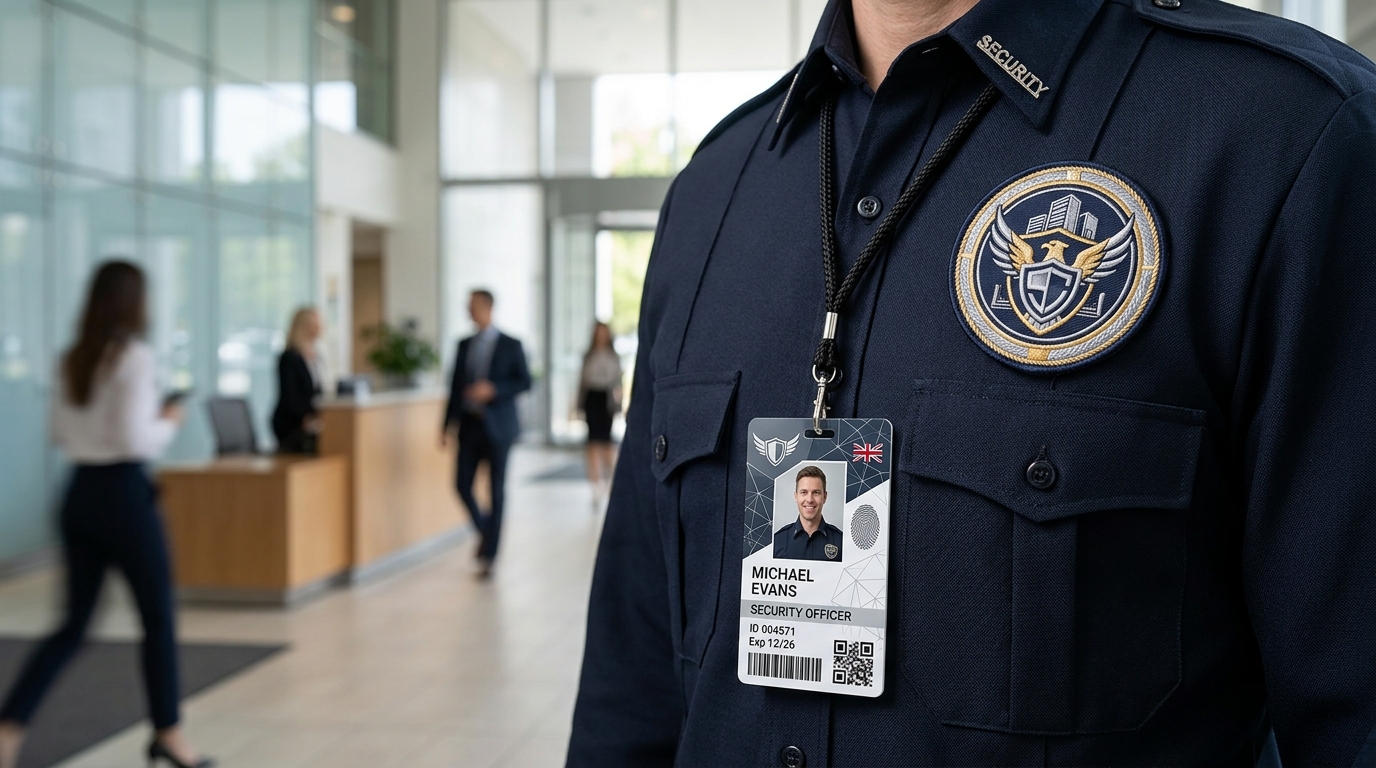
Security patches are an important part of professional uniforms, helping organizations identify their personnel, display company branding, and maintain a consistent appearance. Whether used by private security companies, corporate facilities, event management teams, industrial sites, or residential communities, custom security patches make uniforms more recognizable and organized.
A professionally designed patch can display a company logo, employee name, department title, or other relevant identification. It also gives businesses the flexibility to create uniform accessories that match their brand colors, garment styles, and operational requirements.
Organizations can choose from several patch styles, including embroidered, PVC, woven, leather, and hook and loop designs. Each option offers different visual and practical features, making it possible to select a suitable solution for everyday uniforms, outdoor workwear, jackets, security vests, and specialized clothing.
Whether a business needs a few patches for a small team or a large production run for multiple locations, custom security patches can be tailored to its requirements. By selecting appropriate materials, dimensions, backing, and artwork, organizations can create durable and professional-looking uniform identification.
The Importance of Security Patches
Security personnel often work in environments where clear identification matters. Employees may interact with visitors, customers, residents, contractors, and other staff members throughout the day. A recognizable uniform helps people identify authorized personnel and understand who is responsible for security-related duties.
Security patches support this purpose by displaying important information directly on the uniform. A company logo can identify the service provider, while a department patch can distinguish different teams. Name patches can provide additional identification when an organization requires employees to be individually recognizable.
Patches also help businesses maintain a consistent brand image. When employees wear uniforms with matching logos, colors, and identification, the organization presents a more coordinated appearance.
Unlike printing directly onto a garment, patches can often be replaced or updated separately. This can be useful when a company changes its branding, introduces a new department, or needs to replace damaged uniform accessories.
Custom Security Patches for Different Industries
Security requirements vary between organizations. A corporate building may need discreet identification for reception staff, while an outdoor security company may prefer highly visible patches designed for demanding working conditions.
Custom patches allow each organization to create designs that suit its particular environment.
Private Security Companies
Private security companies commonly use patches to display their business name and logo. These patches help employees represent the company consistently at client locations, commercial properties, construction sites, and residential facilities.
A company may choose embroidered patches for traditional uniforms or PVC patches for a more modern appearance. Separate name and department patches can also be added when required.
For companies with multiple teams, a consistent patch design helps create a recognizable uniform standard across different assignments.
Corporate Security Departments
Office buildings, shopping centers, hotels, and commercial properties often employ dedicated security personnel. Their uniforms should look professional while making their responsibilities easy to recognize.
Custom security patches for corporate environments can feature a simple logo, department name, or employee identifier. Clean typography and balanced colors are particularly useful when the organization wants a polished appearance.
Industrial and Warehouse Security
Industrial facilities and warehouses may expose security personnel to dust, moisture, outdoor conditions, and frequent movement. In these environments, patch material and attachment methods should be selected carefully.
PVC patches can be useful where a wipe-clean surface is desirable. Embroidered patches offer a traditional fabric finish, while woven patches can reproduce fine lettering and detailed logos.
The best choice depends on the uniform fabric, expected maintenance, and working conditions.
Event Security Teams
Concerts, exhibitions, sporting events, and private functions often require clearly identifiable security personnel. Custom patches can help distinguish event security staff from organizers, vendors, and general employees.
Hook and loop patches are particularly useful for teams that work at different events and need interchangeable identification. A company can use the same uniform while changing the patch to reflect a specific assignment or department.
Types of Custom Security Patches
Choosing the right patch style is an important part of designing professional uniforms. Different materials offer different appearances, textures, and practical features.
Custom Embroidered Security Patches
Embroidered security patches are a popular choice for traditional uniforms. They are made by stitching colored threads onto a fabric base to create logos, lettering, borders, and symbols.
The raised thread gives embroidered patches a textured appearance that works well with many uniform styles. They are suitable for company names, department titles, shield designs, and simple logos.
Organizations can select different thread colors, background fabrics, borders, and shapes to match their branding.
Embroidered patches are particularly useful when a business wants a familiar, professional uniform appearance. They can be produced in circular, rectangular, shield-shaped, and custom-cut designs.
However, embroidery has practical design limitations. Extremely small text and intricate details may not reproduce clearly. Keeping the artwork simple and selecting an appropriate patch size can improve the finished result.
Custom PVC Security Patches
PVC security patches are made from flexible molded material. They are known for their raised details, defined outlines, and dimensional appearance.
These patches can reproduce lettering, symbols, and layered artwork with a clean finish. Their surface is generally easy to wipe clean, which can make them suitable for uniforms exposed to dust and moisture.
PVC patches are often selected by businesses that want a modern alternative to traditional embroidered designs. They can be used for company logos, department identifiers, and specialized uniform accessories.
The design can incorporate different colors and raised or recessed details. Organizations should consider the size and complexity of the artwork when preparing a PVC patch design.
Custom Woven Security Patches
Woven security patches use fine threads to create detailed artwork. Unlike embroidery, which forms designs with visible stitching, weaving produces a relatively flat surface.
This construction can be useful for logos that contain small lettering, fine lines, or intricate shapes. Woven patches are a good option when the organization wants more detail without a heavily textured finish.
They can be used for company identification, department names, and other uniform details. As with other patch styles, the final dimensions should allow the important information to remain readable.
Custom Leather Security Patches
Leather patches offer a distinctive appearance that differs from conventional fabric badges. They are often used on jackets, outerwear, caps, and selected workwear accessories.
Depending on the production method, designs can be engraved, embossed, debossed, or printed. A leather-style patch may be appropriate for a company logo or a decorative uniform element.
Before choosing leather, organizations should consider the garment and its cleaning requirements. For uniforms that are washed frequently, a fabric or PVC option may be more practical.
Custom Chenille Security Patches
Chenille patches feature a soft, textured surface created with looped yarn. They are commonly associated with large lettering and bold decorative designs.
Although they are less traditional for standard security uniforms, chenille can be considered for specialized jackets, team apparel, or branded merchandise. Organizations should ensure that the design suits the professional appearance they want to maintain.
Hook and Loop Security Patches
Hook and loop backing provides a flexible attachment system for uniforms that need interchangeable identification.
One side of the fastening system attaches to the garment, while the other is attached to the patch. This allows employees or uniform managers to remove and replace patches without permanently stitching every design onto the garment.
This option can be particularly useful for organizations that assign employees to different departments or locations.
Benefits of Removable Security Patches
Removable patches allow a uniform to support multiple identification requirements. A company may use one patch for standard security duties and another for a specific event or assignment.
They can also simplify uniform management when employees change positions or when identification details need to be updated.
For larger security teams, interchangeable patches can reduce the need to maintain entirely separate garments for every role.
Choosing the Correct Hook and Loop Size
The patch dimensions should match the attachment panel on the uniform. Before placing an order, measure the available area and confirm whether the patch should cover the entire panel or only part of it.
Organizations should also confirm whether they need the hook side, the loop side, or both. Some garments already include loop panels, while others may require a complete attachment system.
Custom Security Logo Patches
A company logo is often the main visual element of a security uniform. Custom security logo patches help businesses display their identity in a consistent and recognizable way.
A logo patch can include the company name, symbol, initials, or a combination of these elements. The design should be clear enough to recognize at the intended viewing distance.
When preparing artwork, consider the following:
Use the approved company logo wherever possible.
Keep important lettering readable.
Select colors that match the organization's branding.
Choose a shape that fits the uniform.
Avoid placing important details too close to the border.
Review the artwork at its actual production size.
Some logos need small adjustments before manufacturing. Fine details may need to be simplified for embroidery, while woven or PVC production may support different types of artwork.
For organizations with multiple branches, using the same approved artwork helps maintain brand consistency across all uniforms.
Custom Security Name Patches
Name patches provide individual identification for security employees. They may display a first name, surname, job title, or another approved identifier.
Some companies use separate name patches and company logo patches. This makes it easier to replace employee details without ordering a new company badge.
Other organizations prefer a combined design that includes the business name and employee information.
Embroidered name patches provide a traditional appearance, while woven patches can be suitable for smaller lettering. PVC patches may be selected when a molded finish is preferred.
Readability should always be a priority. Choose lettering that is large enough to recognize and use sufficient contrast between the text and background.
A consistent name format also helps maintain an organized appearance. Using the same font, dimensions, and placement across the team creates a more professional uniform standard.
Security Uniform Patches for Different Garments
Security employees may wear shirts, jackets, vests, caps, and other garments depending on their responsibilities. Each garment has different placement areas and material requirements.
Security Shirt Patches
Security shirts commonly feature patches on the chest or sleeves. A chest patch may display the company logo or employee name, while a sleeve patch may identify the department or organization.
The patch should fit the available space without covering pockets, buttons, or other garment features.
Security Jacket Patches
Jackets can accommodate several patch arrangements. A small logo may be placed on the front, while a larger company name or identification design may appear on the back.
For jackets used outdoors, durability and attachment strength are important considerations. The patch should suit the jacket material and its expected care routine.
Security Vest Patches
Security vests often require clear identification. Patch placement should not interfere with reflective strips, pockets, closures, or other functional features.
A simple, high-contrast design can help make the company or department name recognizable.
Before production, check the dimensions of the vest and the exact placement area.
Security Hat and Cap Patches
Custom hat patches allow organizations to extend their branding to caps and other headwear.
Embroidered, woven, PVC, and leather-style patches can all be considered depending on the design and desired appearance.
Because caps have curved surfaces, patch dimensions and backing should be selected carefully to ensure that the finished patch sits neatly on the front panel.
Designing Professional Security Patches
A good security patch combines clear identification with a balanced design. It should communicate the required information without becoming visually crowded.
Choose a Clear Layout
Start by identifying the most important information. For a company patch, this may be the logo and business name. For an employee patch, it may be the name or department title.
Avoid adding unnecessary words or decorative details that make the design harder to understand.
Select Suitable Colors
Colors should reflect the organization's brand identity while maintaining enough contrast for readability.
A patch with dark lettering on a dark background may be difficult to recognize. Similarly, light text on a pale background can reduce visibility.
A well-balanced color combination improves the overall appearance and helps the patch stand out on the uniform.
Select the Right Shape
Rectangular patches are useful for names and department titles. Circular and shield-shaped patches are common for company logos and organizational designs.
Custom-cut shapes can also be created to complement a particular logo. The final outline should remain practical for attachment and everyday wear.
Consider Patch Size
The patch should fit the garment and display its information clearly.
A large design may look crowded on a small shirt pocket, while a very small patch may make text difficult to read. Measuring the available space before production helps prevent these problems.
Review Artwork Before Manufacturing
Always check the artwork before approving production. Review spelling, colors, logo proportions, patch dimensions, and backing requirements.
A digital proof can help identify mistakes before the order moves into manufacturing.
Choosing the Right Patch Backing
The backing determines how a patch attaches to the uniform. The correct option depends on the garment, material, and whether the patch needs to be removable.
Sew-On Backing
Sew-on patches are attached directly to the garment using stitching. This is a common option for uniforms that will retain the same identification for an extended period.
It is suitable for many embroidered and woven patches and can provide a secure attachment when applied correctly.
Iron-On Backing
Iron-on patches use heat to attach to compatible fabrics. They can be convenient for selected applications, but not every uniform material is suitable for heat application.
Organizations should check garment care instructions and confirm compatibility before selecting this backing.
For uniforms exposed to frequent washing or demanding working conditions, sewing may be a more suitable choice.
Hook and Loop Backing
Hook and loop backing is useful when employees need to change patches regularly. It allows the patch to be removed and replaced while keeping the garment's attachment panel in place.
This option is particularly helpful for security companies with multiple departments or changing assignments.
Adhesive Backing
Adhesive backing may be suitable for temporary applications and selected accessories. However, it may not provide the durability required for uniforms that are frequently washed or worn outdoors.
The intended use should be discussed with the manufacturer before selecting an adhesive option.
Custom Security Patches Wholesale
Security companies and large organizations often require patches in significant quantities. Custom security patches wholesale orders help businesses supply matching identification across their workforce.
Wholesale production can be useful for private security providers, industrial facilities, corporate buildings, hotels, event management companies, and organizations with multiple locations.
Before placing a bulk order, confirm the design, dimensions, materials, backing, colors, and required quantity.
Advantages of Bulk Orders
Bulk production can make it easier to maintain consistent uniforms across a large team. It also allows businesses to plan for employee replacements, new hires, and future uniform requirements.
Depending on the manufacturing process and quantity, larger orders may offer a lower per-unit cost than smaller production runs.
Planning Wholesale Quantities
The required quantity should reflect both current and expected needs.
For example, a company with several branches may need patches for existing employees, replacement garments, and future recruitment. Ordering a reasonable additional quantity can help avoid delays when new uniforms are required.
However, businesses should also consider upcoming branding or uniform changes before committing to a very large order.
Keeping Bulk Orders Consistent
Organizations should maintain approved artwork files and production specifications for repeat orders.
These details may include:
Approved logo artwork.
Patch dimensions and shape.
Thread, fabric, or PVC colors.
Border style and finishing.
Backing type.
Placement instructions.
Keeping these details organized makes repeat production easier and helps ensure that new patches match previous orders.
Custom Security Patches With No Minimum Order
Some businesses need only a small number of patches. A startup security company may have a limited team, while an established organization may need replacement badges or a small batch for a specialized department.
Custom security patches with no minimum order can provide flexibility for these requirements.
Small orders are also useful when a company wants to test a design before moving forward with larger production. A sample or limited run can help evaluate the patch's appearance, dimensions, and suitability for the uniform.
When comparing small-order options, consider the complete price rather than only the cost per patch. Artwork preparation, production setup, materials, and shipping may affect the final amount.
Businesses planning future expansion should keep the approved artwork and specifications so that additional patches can be ordered consistently.
Security Patches for Specialized Departments
Organizations with larger security operations may have different teams responsible for different duties. Department-specific patches can help identify these roles while preserving the company's overall uniform design.
Reception Security
Reception security personnel often work in customer-facing environments. Their patches may use a simple company logo and name identifier that complements the professional appearance of the uniform.
Mobile Patrol Teams
Mobile patrol personnel may work outdoors and travel between multiple locations. Their patches should suit the garment and withstand the conditions associated with regular use.
Access Control Teams
Employees responsible for access control may work at entrances, gates, and restricted areas. Clear department identification can help visitors and staff recognize their responsibilities.
Security Supervisors
Supervisors may wear separate title patches to distinguish their role from other team members.
A removable patch can be useful when employees move between supervisory and standard duties or when assignments change.
Durability and Maintenance
Security patches are often worn repeatedly, so material quality and attachment should be considered during the ordering process.
The expected lifespan depends on the patch construction, garment, working environment, attachment method, and care routine.
Follow Uniform Washing Instructions
Always follow the garment manufacturer's washing instructions. Excessive heat, harsh detergents, or unsuitable cleaning methods may affect certain patch materials and backing systems.
If a patch is removable, taking it off before washing may help protect the attachment system, depending on the garment design.
Check Patch Attachment
Uniform managers should periodically inspect patches for loose stitching, lifting edges, or damaged backing.
A patch that becomes loose or damaged should be repaired or replaced to maintain a neat appearance.
Store Replacement Patches Properly
Spare patches should be kept in a clean, dry place away from excessive heat and direct sunlight.
Organizing replacement stock by design, department, and size makes it easier to locate the correct patch when required.
How to Order Custom Security Patches
A clear ordering process helps businesses receive patches that match their uniforms and identification requirements.
Prepare Your Artwork
Start with the company logo, department name, employee information, or other approved design elements.
If possible, provide a high-quality digital logo file. Vector artwork is particularly useful because it can be resized without losing clarity.
Select the Material
Choose embroidered, PVC, woven, leather, or another suitable patch style based on the intended appearance and working conditions.
Consider where the patch will be used and how frequently the uniform will be cleaned.
Confirm Dimensions
Measure the available space on the uniform before finalizing the patch size.
The design should be large enough for clear lettering but small enough to fit neatly within the garment's placement area.
Choose the Backing
Decide whether the patch should be sewn on, attached with hook and loop, or produced with another compatible backing.
If the patch needs to be changed regularly, removable backing may be the more practical option.
Approve the Design Proof
Review the final proof carefully. Check spelling, colors, proportions, dimensions, and attachment requirements.
If the order includes multiple patch designs, approve each design separately.
Confirm Quantity and Production Details
Determine how many patches are needed for the current team and whether additional stock is required.
For wholesale orders, confirm that the production specifications are consistent across the complete order.
Working With a Custom Security Patch Manufacturer
Choosing a reliable custom security patch manufacturer can help businesses create patches that match their branding and uniform requirements.
An experienced manufacturer should be able to discuss material choices, backing options, artwork preparation, dimensions, and production specifications.
It is useful to explain how the patches will be used. A manufacturer can provide more relevant recommendations when it knows whether the patches are intended for indoor uniforms, outdoor patrol clothing, jackets, vests, caps, or removable panels.
Before confirming an order, review the final design and specifications. This includes the patch material, shape, dimensions, backing, colors, and quantity.
For repeat production, businesses should retain approved artwork and order details. This makes it easier to reorder matching patches when new employees join or existing uniforms need replacement.
Common Mistakes to Avoid
Ordering custom patches involves several details that should be checked before manufacturing begins.
One common mistake is choosing a material based only on appearance. A patch may look attractive in a preview but may not suit the garment or working environment.
Another issue is using lettering that is too small. Important information should remain readable at the intended viewing distance.
Inconsistent logo files can also create problems. Different versions of a company logo may result in visible differences between employee uniforms.
Incorrect dimensions can cause patches to overlap pockets, cover garment features, or fail to fit existing attachment panels.
Businesses should also confirm the backing type before production. A patch designed for sewing will not automatically suit a uniform that requires removable hook and loop identification.
Reviewing all specifications before approval helps reduce these common ordering problems.
Conclusion
Custom security patches provide a practical way to improve uniform identification, support company branding, and create a consistent appearance across security teams. From embroidered company badges and PVC logo patches to woven name patches and removable hook and loop designs, organizations have several options to match their uniforms and working requirements.
Businesses can choose materials, shapes, colors, dimensions, and backing methods according to their needs. Small orders can support new companies and replacement requirements, while custom security patches wholesale production can help larger organizations maintain consistent identification across multiple teams and locations.
The best results come from clear artwork, suitable materials, accurate sizing, and the correct attachment method. By reviewing these details before production, organizations can create professional security patches that complement their uniforms and represent their brand effectively.

Discussion & Feedback 0
Write a CommentNo comments yet
Have a question or feedback regarding this topic? Be the first to share your thoughts below!
Leave a Reply
Your email address will not be published. Required fields are marked *