When brands, artists, and athletic leagues set out to create custom textile emblems, they inevitably face a critical fork in the road: Should you choose classic embroidered patches or high-definition woven patches?
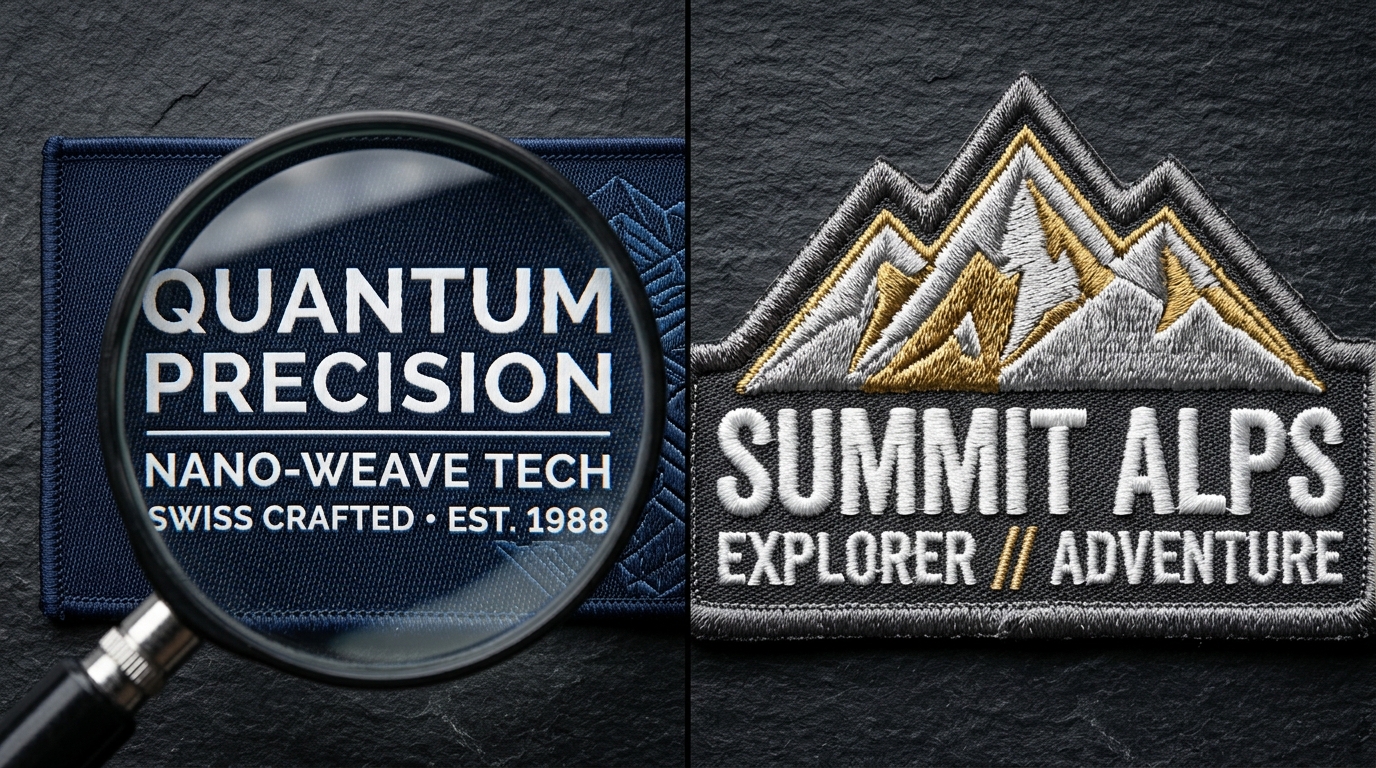
To an untrained eye, both styles look like thread-based fabric badges. However, under a 10x jeweler’s loupe, the difference between embroidery and weaving is as profound as the difference between a bold oil painting and a 4K digital print. Choosing the wrong style can turn intricate typography into unreadable thread blobs or strip your heritage crest of its beloved three-dimensional tactile texture.
In this technical textile breakdown from Patched Custom, our industrial weaving technicians and master digitizers compare thread gauge chemistry, loom physics, micro-lettering thresholds, profile flexibility, and cost economics to help you make the perfect choice for your brand.
The Mechanical Difference: Needle Punching vs. Jacquard Looms
To understand why woven patches achieve three times greater graphical resolution than embroidery, you must understand how each is physically manufactured:
Custom Embroidered Patches (Needle-Punched onto Twill)
In embroidery, your design is stitched on top of a pre-existing woven substrate (typically heavy polyester twill). Industrial multi-needle machines (such as 15-needle Tajima systems) drive needles threaded with 40-weight trilobal polyester thread (approximately 120 to 135 denier) up and down through the twill. Because the threads sit on top of the fabric, they create a rich, three-dimensional, embossed topography with radiant light reflection.
Custom Woven Patches (Woven from Scratch on Jacquard Looms)
In weaving, there is no base fabric substrate. Instead, hundreds of ultra-fine 50-denier to 70-denier Damask polyester threads are loaded onto high-speed electronic Jacquard weaving looms. The warp (vertical) and weft (horizontal) threads cross over and under one another simultaneously. In essence, the patch’s design and its structural fabric are born together in a single continuous weaving process. The resulting emblem is flat, smooth, and razor-sharp.
Typography & Micro-Detail: When You MUST Choose Woven
The single greatest cause of patch manufacturing defects is trying to embroider artwork containing typography that violates the physical laws of needle and thread.
Consider an embroidery needle: an industrial #11/75 needle has an outer diameter of 0.75mm. When combined with 40wt thread looping back and forth in a satin stitch, any letter stroke thinner than 1.0mm or text shorter than 4.0mm (approx 0.16 inches) causes the thread loops to crash into one another. Letters like "e", "a", "s", and "b" fill in, turning into illegible thread knots.
Because Jacquard looms interlace microscopic 50-denier threads with zero needle punching trauma, woven patches render lowercase text down to 1.5mm high, sharp 0.2mm fine linework, complex copyright symbols (©, ™), serial numbers, and intricate crest details with photographic clarity.
When Is Embroidered Superior to Woven?
If woven patches offer such extreme clarity, why do embroidered patches continue to dominate the global custom patch market? The answer comes down to depth, heritage, and perceived value:
- Tactile Luxury & Perceived Retail Value: Woven patches, while sharp, can occasionally feel similar to an interior clothing care label due to their smooth, flat surface. Embroidered patches feel chunky, expensive, and substantial in the consumer’s hand.
- Vintage & Americana Heritage: For biker cuts, military flight jackets, scouting uniforms, and vintage workwear, flat woven patches look historically inaccurate. The thick satin stitches and raised twill valleys of embroidery provide authentic Americana charm.
- Thick Structured Caps (Richardson 112 Truckers): On heavy canvas and mesh trucker caps, thin woven patches can sometimes sink into thick crown seams unless laminated with heavy buckram backing. Embroidered patches possess the intrinsic rigidity to bridge seams effortlessly.
- Short-Run Affordability: Setting up an electronic Jacquard loom involves warping hundreds of individual yarn bobbins, requiring a higher minimum setup threshold. For small orders of 25 to 50 patches, embroidery offers lower setup costs.
Electronic Jacquard Loom Mechanics vs. Multi-Needle Heads
To grasp why woven patches deliver unprecedented graphical clarity, we must inspect the inner workings of an industrial electronic Jacquard weaving loom (such as Dornier or Staubli systems):
- Warp & Weft Coordinate Arrays: An electronic Jacquard loom controls up to 10,000 individual vertical warp threads independently via computer actuators. As horizontal weft yarn shuttles travel across the loom bed at 800 picks per minute, warp threads raise and lower according to your digital design matrix.
- Damask Weaving Density: High-definition custom patches utilize ultra-dense Damask 50-Denier polyester yarns. With warp densities exceeding 100 threads per inch, the microscopic threads pack together tightly, yielding a smooth, continuous surface texture with zero twill background gaps.
- Color Count Architecture: In embroidery, you are physically limited to the 9 to 15 needle positions on the machine head. In Jacquard weaving, up to 8 weft color shuttles can be interlaced in combinations that simulate hundreds of tonal color gradations through micro-stippling.
Typography Benchmark: 1.5mm Woven vs 4.0mm Embroidered
To demonstrate the graphical resolution gap between embroidery and weaving, consider this real-world typography stress test conducted in our manufacturing laboratories:
Performance Sportswear Integration: Soccer Crests & BJJ Gis
In high-performance athletics, garment weight and friction resistance are critical parameters. Heavy embroidered badges with thick Merrowed borders add unnecessary weight and can cause uncomfortable skin chafing against sweaty athletic torsos.
High-definition woven patches have become the global standard for elite sports apparel:
- FIFA / Professional Soccer Club Crests: Applied to lightweight polyester jerseys using ultra-thin woven badges with laser-cut edges and heat-seal backings. Weighs less than 4 grams, ensuring zero impact on athlete agility.
- Brazilian Jiu-Jitsu (BJJ) & Martial Arts Gis: Large 10-inch shoulder and back woven patches lie completely flat against heavy 450 GSM pearl-weave cotton gis, sliding smoothly across tatami mats without catching on opponent fingers or tearing.