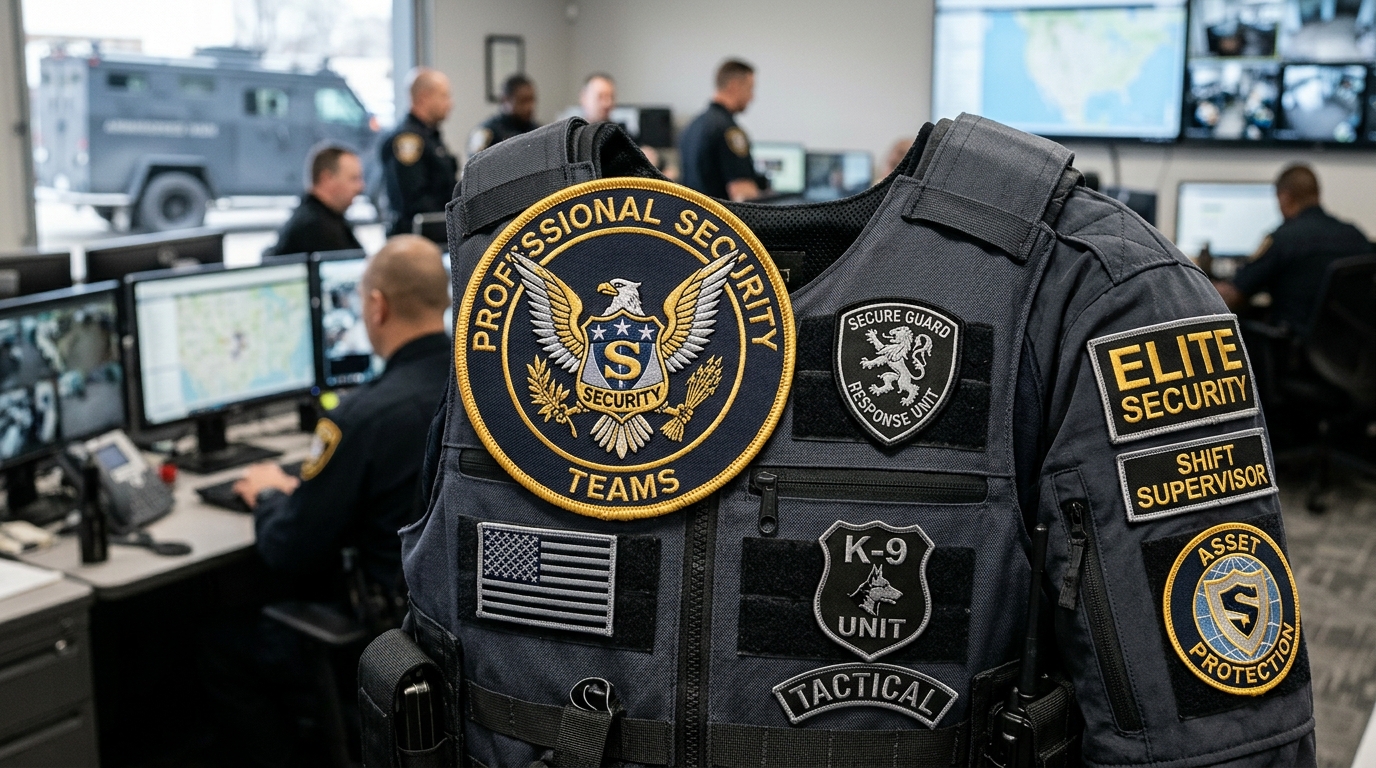
Security patches are an essential part of professional uniforms, helping organizations create a consistent appearance, identify their personnel, and display important branding and information. From private security companies and event security teams to corporate facilities, residential communities, and industrial security departments, custom security patches provide a practical way to make uniforms recognizable and professional.
A well-designed patch does more than display a company name or logo. It helps distinguish employees from visitors, supports team identification, and gives uniforms a polished and organized look. Whether an organization needs embroidered name patches, PVC logo patches, hook and loop patches, or custom security badges, choosing the right design and material makes a noticeable difference.
Businesses looking to update their uniforms often prefer custom security patches because they can be produced in different shapes, sizes, colors, and materials. Organizations can order patches featuring their company logo, department name, employee identification, or other approved details. With options for individual requirements and larger production runs, custom patches are suitable for both small security teams and large organizations.
Why Security Patches Matter for Professional Uniforms
Uniforms play an important role in security operations. They help employees look professional, make personnel easier to recognize, and create a consistent visual identity across different locations. Security patches add another layer of identification by displaying the information that matters to an organization.
For example, a security officer working at a commercial building may wear a patch displaying the company name, while an employee assigned to a warehouse may need a department-specific design. A supervisor may wear a different patch to make their role clear. These details help create a more organized appearance without requiring completely different uniforms for every position.
Custom security patches also help organizations maintain brand consistency. When the same logo, colors, and typography appear across uniforms, employees present a unified image. This is particularly valuable for companies that operate at multiple sites or employ large teams.
Another important advantage is flexibility. Instead of printing identification directly onto every uniform, organizations can use patches that can be attached, removed, or replaced depending on their needs. This makes it easier to update employee names, department details, or branding when necessary.
Custom Security Patches for Different Organizations
Security requirements vary from one workplace to another. A private security company may need patches for patrol officers, supervisors, and reception security staff. A manufacturing facility may require department identification for employees responsible for access control and site monitoring. Event security teams may need temporary or specialized patches for a particular assignment.
Custom patches can be designed around these different requirements.
Private Security Companies
Private security businesses often use uniform patches to display their company name and logo. These patches help employees represent the organization consistently while making their uniforms easier to recognize.
A company may choose an embroidered patch for its standard uniform, a PVC patch for outdoor assignments, or a hook and loop design that allows employees to change identification when moving between roles.
The design can include the company name, a logo, a department title, or other appropriate identifying information. Consistent placement and sizing across uniforms help maintain a professional appearance.
Corporate and Commercial Security Teams
Office buildings, shopping centers, hotels, and commercial facilities often employ security personnel who interact with employees, customers, and visitors. Clear uniform identification helps people recognize authorized security staff.
Custom security patches for corporate environments usually focus on readability and a clean design. A simple logo, department name, and contrasting colors can make a patch easy to identify without making the uniform look crowded.
Organizations may also use different patch designs for front-desk security, mobile patrols, and supervisory personnel.
Industrial and Warehouse Security
Industrial sites and warehouses may expose security employees to dust, moisture, frequent movement, and demanding working conditions. In these environments, patch material and construction deserve particular attention.
PVC patches can be useful where moisture resistance and easy cleaning are priorities. Embroidered patches are another option when an organization wants a traditional fabric appearance. The best choice depends on the uniform fabric, working environment, and expected maintenance requirements.
Event and Venue Security
Concerts, exhibitions, sporting events, and private functions often require temporary security teams. Custom patches can help event organizers distinguish security personnel from other staff members.
For recurring events, reusable patches can be designed around the event organizer's branding or the security provider's identity. Hook and loop backing is particularly useful when the same uniform needs to support different assignments.
Choosing the Right Material for Security Patches
The material used for a security patch affects its appearance, durability, texture, and suitability for different working conditions. There is no single material that works best for every organization. The right choice depends on the uniform, design complexity, attachment method, and environment.
Custom Embroidered Security Patches
Embroidered patches are a popular option for traditional security uniforms. They use stitched thread to create lettering, borders, symbols, and logos on a fabric base.
Their textured surface gives uniforms a classic professional appearance. Embroidery works particularly well for company names, department titles, simple logos, and designs that benefit from visible stitching.
Organizations can select different thread colors and patch shapes to match their branding. Common shapes include circles, rectangles, shields, and custom outlines.
For a security company that wants a conventional uniform style, custom embroidered security patches can be an effective choice. They are also suitable for bulk orders when multiple employees need matching identification.
The design should be prepared with the embroidery process in mind. Very small lettering, extremely thin lines, and complicated details may not reproduce clearly at small sizes. A simplified design can improve readability and create a cleaner finished patch.
Custom PVC Security Patches
PVC patches are made from flexible molded material. They are known for their raised details, defined edges, and ability to reproduce designs with a dimensional appearance.
Custom PVC security patches are suitable for uniforms used in outdoor environments or workplaces where patches may be exposed to moisture and dirt. Their surface can generally be wiped clean, making routine maintenance straightforward.
PVC also allows designers to create clear lettering, symbols, and layered visual details. This makes it useful for organizations that want a modern alternative to traditional embroidery.
A company can use PVC patches for its main logo, security department identification, or specialized uniform designs. The material is particularly useful when the organization wants a distinctive appearance that stands apart from standard fabric patches.
Custom Woven Security Patches
Woven patches use fine threads woven together to create a detailed design. Because the artwork is formed through weaving rather than thick embroidery stitches, they can reproduce smaller lettering and finer details.
This makes woven security patches suitable for logos that include narrow lines, compact text, or intricate symbols. They can provide a flatter finish than embroidered patches, which may be useful when the design needs to remain relatively smooth.
Organizations should consider woven patches when visual detail and text clarity are important. The final size should still be large enough to make the information readable when the patch is attached to a uniform.
Custom Leather Security Patches
Leather patches offer a distinctive appearance and are often selected for uniforms, jackets, or specialized workwear where a different visual style is desired.
They can feature engraved, embossed, debossed, or printed details depending on the material and production method. A leather-style patch may be suitable for a company logo or a decorative uniform element.
Before selecting leather, organizations should consider the working environment and uniform requirements. For standard security shirts that are frequently washed, another material may be more practical. Leather-style patches are often better suited to jackets, outerwear, and selected accessories.
Hook and Loop Security Patches for Flexible Uniforms
Hook and loop backing is one of the most practical attachment options for organizations that need interchangeable uniform identification.
A hook and loop patch can be removed from a compatible uniform panel and replaced with another patch. This is useful when employees move between departments, work at different locations, or need different identification for specific assignments.
For example, a security company may use one patch for standard patrol duties and another for event assignments. A supervisor may use a different title patch without changing the entire uniform.
Benefits of Removable Patches
Removable patches provide flexibility in situations where uniform details change regularly. Organizations can keep a consistent uniform while updating selected identification elements.
They can also make uniform maintenance easier. Depending on the garment and attachment system, patches may be removed before washing or when a uniform needs to be reassigned.
For businesses that manage large teams, this flexibility can help simplify uniform planning. Instead of maintaining entirely separate garments for every role, a company may use compatible uniform panels with interchangeable patches.
Designing Hook and Loop Backing
When ordering custom hook and loop security patches, organizations should confirm the required dimensions and backing arrangement.
The patch should match the available attachment panel on the uniform. A patch that is too large may overlap the panel, while one that is too small may not sit securely.
It is also important to confirm whether the order includes the hook side, the loop side, or both. Some uniforms already have loop panels attached, while other applications may require a complete attachment system.
Custom Security Logo Patches
A company logo is often the most recognizable element of a security uniform. Custom security logo patches allow organizations to display their visual identity in a consistent format across different garments.
A logo patch can include a company symbol, brand name, initials, or a combination of these elements. The design should remain clear when viewed from a normal distance.
When preparing artwork, organizations should consider the following details:
The logo should be clear and easy to recognize.
Text should be large enough to remain readable.
Colors should match the company's approved branding.
The patch shape should complement the uniform.
Important design elements should not be placed too close to the edge.
A complicated logo may need slight adjustments for embroidery or weaving. These changes should preserve the brand's overall appearance while making the design suitable for production.
For organizations with multiple branches, using the same approved logo artwork across all locations can help maintain a unified identity.
Custom Security Name Patches
Name patches provide a simple way to identify individual security employees. They can display a first name, surname, employee number, or another approved identifier.
A name patch may be used alongside a company logo patch or as part of a combined design. Some organizations prefer separate name and company patches because they allow employee details to be changed without replacing the main logo.
Custom security name patches are available in different materials and attachment styles. Embroidered name patches provide a traditional uniform appearance, while woven patches can support smaller text. PVC may be suitable for organizations that prefer a molded design.
Readability is especially important for name patches. The lettering should be large enough to recognize without requiring someone to stand very close to the employee. High contrast between the text and background can improve visibility.
Organizations should also establish a consistent format for names and titles. Using the same font, dimensions, and placement across uniforms helps avoid an inconsistent appearance.
Security Uniform Patches for Different Garments
Security employees may wear several types of garments depending on their duties and the workplace. A patch designed for one garment may not be suitable for another, so it is important to consider the fabric and intended placement before ordering.
Security Shirt Patches
Security shirts are among the most common garments used for employee identification. Patches may be positioned on the chest, sleeves, or another location specified by the uniform design.
A chest patch can display a company logo or employee name, while a sleeve patch may carry a department title or organizational symbol.
The size should be appropriate for the available space. Oversized patches can make a shirt look crowded, while very small designs may be difficult to read.
Security Jacket Patches
Jackets often provide more room for larger patch designs. Companies may use a logo on the front and a larger company name or security identification on the back.
Jacket patches should be selected with the garment material in mind. Heavy fabrics may support different attachment methods than lightweight outerwear.
For jackets used outdoors, durability and attachment strength are particularly important. The patch should be suitable for repeated wear and normal garment care.
Security Vest Patches
Security vests are often used in environments where employees need clearly visible identification. Patches on vests should be positioned so they remain easy to see and do not interfere with pockets, closures, reflective elements, or other functional features.
A simple, high-contrast design can help make the company or department name recognizable.
Before production, it is useful to confirm the vest dimensions and the exact placement area. This helps ensure that the finished patch fits the garment properly.
Security Cap and Hat Patches
Some organizations include branded caps or hats as part of their uniform. Custom hat patches can display a company logo, initials, or department identification.
Embroidered, woven, PVC, and leather-style patches can all be considered depending on the desired appearance and cap construction.
Because caps have curved surfaces, patch dimensions and attachment methods should be checked before ordering. A design that is too wide or rigid may not sit neatly on a curved panel.
Designing Security Patches That Look Professional
An effective security patch should balance appearance with practical identification. It needs to communicate the right information without becoming difficult to read or visually crowded.
The design process should begin with the purpose of the patch. A company logo patch has a different job from an employee name patch or department identifier. Once the purpose is clear, it becomes easier to select the right dimensions, material, and layout.
Keep the Main Information Clear
The most important information should be easy to recognize. For a company patch, this may be the business name or logo. For an employee patch, it may be the person's name or job title.
Avoid including unnecessary text. Too many words can make a patch look crowded and reduce readability, particularly when the design is small.
Use Consistent Brand Colors
Color selection should follow the organization's branding guidelines where possible. Consistent colors help connect the uniform to the company's wider identity.
Contrast also matters. Light lettering on a light background may be difficult to read, while a clear contrast between text and background can improve visibility.
Select an Appropriate Shape
The patch shape should support the artwork and fit the garment. Rectangular patches work well for names and department titles. Circular and shield-shaped patches are common choices for logos and organizational symbols.
Custom outlines can also be created around a logo or distinctive design. However, the shape should not make the patch difficult to attach or position.
Check the Artwork Before Production
Organizations should review the final artwork carefully before approving an order. This includes checking spelling, colors, dimensions, logos, and placement.
A digital preview can help identify design problems before manufacturing begins. It is particularly useful for larger orders, where a small mistake could affect many uniforms.
Choosing the Right Patch Attachment
The attachment method affects how a patch is installed and how well it stays in place. The best option depends on the garment, how frequently the patch needs to be changed, and the conditions in which the uniform is worn.
Sew-On Patches
Sew-on patches are attached directly to the garment with stitching. They are a common choice for uniforms that are intended to keep the same identification for an extended period.
This option can provide a secure attachment when the stitching is appropriate for the patch and garment. It is particularly suitable for standard embroidered, woven, and some other fabric-based patches.
Iron-On Patches
Iron-on backing uses heat to attach a patch to compatible fabric. It can be convenient for certain uniform applications, but the garment material and care instructions must be checked first.
Not every fabric is suitable for heat application. Some materials may be damaged by high temperatures, and repeated washing or demanding working conditions may affect the bond.
For uniforms that experience frequent movement or heavy use, organizations may prefer sewing or another attachment method.
Hook and Loop Backing
Hook and loop backing is useful when patches need to be removed and replaced. It is commonly selected for uniforms with compatible loop panels.
This option is particularly practical for security teams that use different identification for various assignments or need to update employee details.
Adhesive Backing
Adhesive backing may be suitable for temporary applications or certain accessories. However, it is not always the best choice for uniforms that are frequently washed or exposed to demanding conditions.
Organizations should confirm the intended use with the patch manufacturer before selecting adhesive backing for regular uniform wear.
Custom Security Patches Wholesale
Organizations with multiple employees often need patches in larger quantities. Custom security patches wholesale orders can help businesses maintain consistency across their workforce while planning their uniform requirements more efficiently.
Wholesale production is useful for private security companies, corporate facilities, industrial sites, event service providers, and organizations that manage multiple branches.
When preparing a wholesale order, it is important to establish the required quantity, patch dimensions, material, colors, backing, and artwork. Providing these details early can help reduce delays and prevent misunderstandings.
Benefits of Ordering in Bulk
Bulk orders can make it easier to supply matching patches to an entire team. They can also support future uniform planning by giving an organization a consistent stock of approved identification.
For businesses that regularly hire new employees, keeping additional patches available can help maintain uniform standards as the workforce changes.
Larger orders may also offer more economical per-unit production costs, depending on the design, material, manufacturing process, and quantity.
Planning the Right Quantity
The order quantity should reflect the number of uniforms currently in use as well as expected future requirements.
A company may need patches for existing employees, replacement garments, new hires, and additional locations. Ordering only the exact current requirement can make it harder to respond quickly when the team expands.
At the same time, organizations should avoid ordering excessive quantities of designs that may soon become outdated. If a logo, department name, or uniform policy is likely to change, the production quantity should account for that possibility.
Maintaining Consistency Across Large Orders
Consistency is especially important for organizations that use several uniform suppliers or operate in multiple locations.
The company should maintain approved artwork files and clear production specifications. These can include patch size, thread or material colors, backing type, border style, and placement instructions.
Keeping these details documented makes repeat orders easier and helps ensure that replacement patches match previous production runs.
Custom Security Patches With No Minimum Order
Not every organization needs a large quantity of patches. A small security business may have only a few employees, while a new company may want to test a design before placing a larger order.
Custom security patches with no minimum order can be useful for these situations. They allow businesses to explore design options without committing to a large production quantity.
Smaller orders may also suit organizations that need replacement patches, samples, or a limited number of specialized designs.
When comparing small-order options, businesses should consider the complete cost rather than focusing only on the price per patch. Setup requirements, artwork preparation, material selection, and shipping can all affect the final amount.
For organizations planning to expand, it may be useful to choose a design that can be reordered later. Keeping the original artwork and production details can make future orders more consistent.
Security Patches for Specialized Departments
Large organizations may divide security responsibilities into several departments. Different patch designs can help distinguish these teams while keeping the overall uniform style consistent.
For example, an organization may have separate teams for reception security, mobile patrol, access control, event support, and site supervision.
The patches do not need to look completely different. A consistent company logo combined with a department-specific title can provide clear identification without creating an unrelated uniform design for each team.
Reception and Front Desk Security
Reception security staff often work in customer-facing environments. Their uniforms may benefit from clean, understated patches that fit the professional appearance of an office, hotel, or commercial building.
A small logo patch and readable name patch can provide sufficient identification while keeping the uniform simple.
Mobile Patrol Teams
Mobile patrol employees may work outdoors or move between different sites. Their patches should be selected with the garment and working conditions in mind.
Durable construction and suitable attachment are important for uniforms exposed to frequent movement, changing weather, and regular cleaning.
Access Control Personnel
Employees responsible for access control may work at entrances, gates, and restricted areas. Clear department identification can help visitors and staff recognize their role.
The design should prioritize readability and use consistent branding so the patch fits naturally into the organization's uniform system.
Supervisors and Team Leaders
Supervisors may require a different title or identifier to distinguish their role. A separate title patch can be an effective way to communicate this information.
Using removable backing may be helpful when supervisory assignments change or when employees move between roles.
Durability and Care for Security Patches
Security uniforms are often worn repeatedly, so patch durability should be considered before production. The expected lifespan depends on the material, attachment method, garment, working environment, and care routine.
A patch used on an indoor reception uniform may experience different conditions from one worn by an outdoor patrol employee. The organization should explain these conditions when discussing material options with a manufacturer.
Follow Garment Care Instructions
Uniforms should be washed according to the garment manufacturer's instructions. Excessive heat, unsuitable detergents, or harsh cleaning methods may affect some patch materials and attachment systems.
If a patch is removable, taking it off before washing may help protect the attachment system and the garment, depending on the uniform design.
Inspect Attachment Regularly
Organizations should periodically check whether patches remain securely attached. Loose stitching, damaged backing, or lifting edges can affect the uniform's appearance.
A damaged patch should be repaired or replaced before it becomes difficult to identify.
Store Spare Patches Properly
Extra patches should be stored in a clean, dry place away from excessive heat and direct sunlight. Keeping them organized by design, department, or size can make replacements easier.
For large teams, maintaining a small supply of approved replacement patches can help reduce delays when uniforms need updating.
How to Order Custom Security Patches
Ordering custom security patches becomes easier when the organization prepares its requirements before requesting production.
The process generally begins with the design and ends with a review of the finished product specifications.
Prepare the Design
Start with the company logo, department name, employee identification, or other approved information that needs to appear on the patch.
If the organization already has a logo file, provide the clearest available version. Vector artwork is often useful for production because it can be resized without losing the clarity of the design.
If the artwork is not ready, a manufacturer may be able to help prepare a production-friendly layout.
Choose the Material
Select embroidered, PVC, woven, leather, or another suitable option based on the desired appearance and working conditions.
Consider whether the patch will be used on shirts, jackets, vests, caps, or other garments. The material should suit both the uniform and the design.
Confirm the Dimensions
Measure the available placement area on the garment. This helps prevent a patch from being too large or too small.
The dimensions should also account for text readability. If a patch includes a long company name, the layout may need more width or a different arrangement.
Select the Backing
Decide whether the patch should be sewn on, attached with hook and loop, applied with heat, or produced with another backing option.
The decision should reflect how often the patch needs to be changed and whether the garment is compatible with the selected method.
Review the Proof
Before approving production, carefully review the design preview and specifications.
Check the spelling, logo proportions, color choices, patch shape, dimensions, and backing. If the order includes several designs, review each one separately.
Confirm the Order Quantity
Determine how many patches are required for the current team and whether extra stock is needed for future employees or replacements.
For wholesale orders, confirm that all patches use the approved design and specifications.
Working With a Custom Security Patch Manufacturer
Choosing an experienced custom security patch manufacturer can help an organization move from an initial idea to a finished uniform accessory.
A suitable manufacturer should be able to discuss different materials, explain attachment options, review artwork, and clarify production specifications.
Organizations should provide accurate information about how the patches will be used. A manufacturer can make more useful recommendations when it knows whether the patches are intended for indoor uniforms, outdoor patrol clothing, jackets, vests, or removable identification panels.
It is also important to review production details before confirming the order. These details include the final dimensions, material, backing, colors, quantity, and any special finishing requirements.
For repeat orders, keeping the approved artwork and specifications is valuable. It allows the business to request matching patches when employees join, uniforms are replaced, or additional branches are opened.
Clear communication throughout the ordering process helps reduce the risk of errors and makes it easier to achieve a consistent result.
Security Patch Ideas for a Stronger Brand Identity
A security patch does not need to contain a complicated design to look professional. In many cases, a simple layout is more effective because it makes the company name and logo easier to recognize.
Organizations can explore different design approaches depending on their branding and uniform style.
A traditional embroidered shield may suit a company that prefers a classic uniform appearance. A clean rectangular patch can work well for names and department titles. A molded PVC logo may provide a more modern look, while a woven patch can support fine lettering and detailed artwork.
Some companies choose a single standard patch for every employee, while others use a coordinated collection for different departments. Both approaches can work when the design system is consistent.
The most important consideration is that the patch should support identification and branding rather than distract from the uniform. Good spacing, readable text, appropriate colors, and a suitable size help create a balanced design.
Common Mistakes to Avoid When Ordering Security Patches
Even a well-planned patch order can run into problems if important details are overlooked.
One common mistake is choosing a material based only on appearance. A patch may look attractive in a digital preview but may not be the most suitable option for the garment or working environment.
Another issue is using text that is too small. Security patches often need to be recognized from a normal viewing distance, so important information should remain readable after production.
Organizations should also avoid inconsistent logo files. Using different versions of a company logo across separate orders can create noticeable differences between employee uniforms.
Incorrect dimensions can cause another problem. A patch may overlap a pocket, cover a garment feature, or fail to fit an existing attachment panel if the placement area has not been measured.
Finally, some businesses approve production without checking the backing. This can lead to patches that do not attach properly to the intended uniform.
Reviewing material, dimensions, artwork, backing, and quantity before production can prevent many of these issues.
The Value of a Consistent Security Uniform
A professional uniform is made up of several details working together. The garment, colors, footwear, identification, and patches all contribute to the overall appearance.
Custom security patches help connect these elements by giving employees a recognizable company identity. They can identify the organization, distinguish departments, and provide a consistent visual standard across different teams.
For a small company, a carefully designed patch can help establish a professional image from the beginning. For a larger organization, standardized patches can support uniform consistency across multiple locations and departments.
The right patch also needs to be practical. It should suit the garment, remain readable, and use an attachment method that matches the way the uniform is worn and maintained.
By considering these factors during the design and ordering process, businesses can create patches that support both their branding and everyday uniform requirements.
Conclusion
Custom security patches are a practical and versatile way to improve uniform identification, strengthen company branding, and create a consistent appearance across security teams. Whether an organization needs embroidered company badges, PVC logo patches, woven name patches, leather-style designs, or removable hook and loop identification, the right solution depends on its uniforms, working conditions, and design requirements.
Businesses can choose from different materials, shapes, sizes, colors, and backing options to create patches that reflect their identity. Small orders can support new companies and replacement requirements, while custom security patches wholesale production can help larger organizations supply matching identification across their workforce.
A successful order starts with clear artwork, suitable materials, accurate dimensions, and the correct attachment method. Reviewing these details before production helps ensure that the finished patches fit the uniforms and communicate the intended information.
With thoughtful design and consistent production specifications, security patches can become a valuable part of a professional uniform system, helping employees represent their organization with a clear and recognizable identity.


Discussion & Feedback 0
Write a CommentNo comments yet
Have a question or feedback regarding this topic? Be the first to share your thoughts below!
Leave a Reply
Your email address will not be published. Required fields are marked *