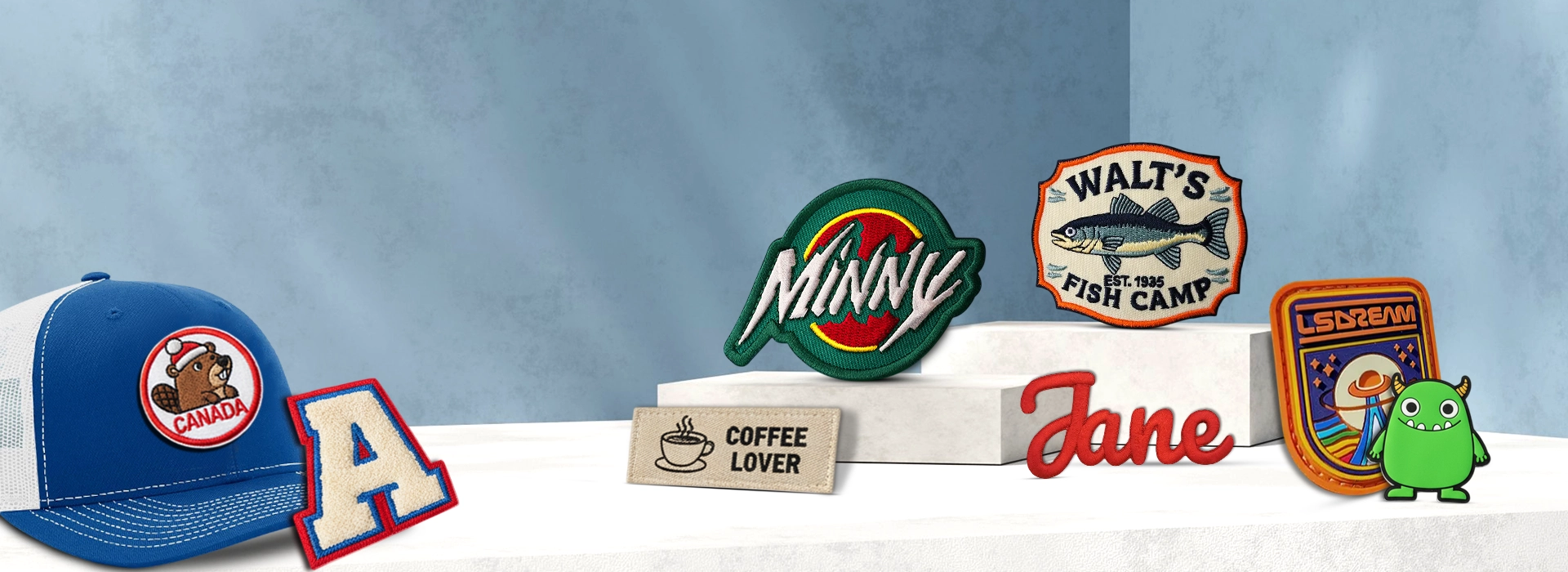
Whether you are outfitting an international motorcycle club, launching a high-end streetwear merchandise capsule, establishing corporate uniforms for enterprise staff, or outfitting military tactical units, custom embroidered patches stand as the timeless gold standard of fabric embellishment. Their rich three-dimensional tactile topography, vibrant thread luster, and multi-decade longevity elevate garments far beyond flat screen printing, vinyl heat transfers, or direct-to-garment digital prints.
Yet, when first-time designers, apparel brand founders, or procurement officers set out to order custom embroidered patches, they frequently confront an intimidating maze of manufacturing terminology: 50% versus 75% versus 100% thread coverage, spun polyester vs. viscose rayon threads, merrowed overlock edging versus precision laser-cut borders, twill backing weights, and thermoplastic heat-seal versus hook-and-loop Velcro backings. Making the wrong selection can lead to patches that curl on caps, pucker after the first wash, or render intricate brand typography unreadable.
At Patched Custom, our master digitizers and industrial embroidery technicians have engineered millions of custom emblems for global apparel labels, emergency services, tactical units, and artisan brands. This comprehensive 2026 manufacturing manual breaks down every mechanical nuance, fabric science principle, and digitizing rule you need to know to create custom embroidered patches that look extraordinary, withstand fifty commercial wash cycles, and command premium retail value.
What Are Custom Embroidered Patches? Anatomy & Manufacturing Physics
Unlike direct-to-garment (DTG) embroidery—where multi-needle commercial heads stitch thread straight into the finished apparel chest, sleeve, or cap crown—a custom embroidered patch is an autonomous decorative badge crafted onto a dedicated heavy-duty substrate, enclosed with reinforced perimeter stitching, and bonded to an engineered backing layer.
This independent modular construction grants custom patches three decisive operational advantages over direct garment embroidery:
- Universal Versatility: Patches can be applied to heavy leather motorcycle cuts, 6-panel structured trucker hats, ballistic Cordura plate carriers, winter parkas, and canvas duffel bags that could never fit inside a standard flatbed embroidery machine hoop.
- Flawless Replacement & Transferability: If an employee changes rank or a motorcycle rider switches chapters, a patch can be removed, updated, or transferred to new outerwear without discarding an expensive leather or insulated jacket.
- Bulk Cost Efficiency & Modular Inventory: Producing 500 or 1,000 patches simultaneously on automated multi-head industrial embroidery machines (such as 15-needle Tajima or Barudan commercial arrays) costs a fraction of embroidering 500 individual bulky jackets. You can store 1,000 patches in a small shoebox and press them onto apparel on-demand as customer orders arrive.
The 4 Structural Layers of Every Embroidered Patch
- The Substrate (Base Twill): A heavy tightly woven twill fabric—typically 65% polyester / 35% cotton or 100% heavy poly-twill (7.5 to 8.5 oz/yd²)—that provides foundational tensile stability and dimensional resistance against warping under thread tension.
- The Decorative Stitching: Hundreds to tens of thousands of individual satin, tatami fill, and running stitches created with vibrant 40-weight trilobal polyester or rayon embroidery thread.
- The Enclosing Border: A protective outer perimeter (either a round merrowed overlock cord or a sharp heat-cut/laser-cut edge) that prevents the substrate from fraying and gives the emblem structural integrity.
- The Functional Backing: A specialized secondary coating—such as PVC plastic stiffener, heat-seal iron-on dry film, Velcro hook-and-loop, or peel-and-stick adhesive—that governs how the badge affixes to textiles.
Understanding Thread Coverage: 50% vs. 75% vs. 100%
One of the most consequential decisions when ordering custom embroidered patches is selecting your thread coverage percentage. Coverage dictates how much of the patch’s visible surface area is covered with needlework versus how much of the underlying woven twill substrate remains visible as the background.
Choosing 100% coverage delivers maximum stitch density and complete color saturation, but it also increases the stiffness and weight of the badge. For curved baseball caps or lightweight summer polo shirts, 75% coverage is often preferable because the exposed twill background provides natural flexibility that conforms smoothly to the forehead curvature.
Thread Science: Polyester vs. Rayon vs. Metallic & Glow Threads
Not all embroidery threads are created equal. The physical composition of the fiber determines whether your patch maintains its brilliant luster through 50 industrial wash cycles or degrades into a faded, frayed disaster:
Trilobal Polyester (The Commercial Industry Standard)
Engineered from synthetic polyethylene terephthalate filaments with a trilobal (three-lobed) cross-section. The triangular fiber shape reflects light dramatically, replicating the sheen of natural silk while offering unbeatable tensile strength.
- Tensile Breaking Strength: Exceptional. Tolerates high-speed industrial stitching up to 1,200 stitches per minute without shredding.
- Chemical & Bleach Resistance: 100% chlorine-bleach safe. Resistant to industrial detergents, pool chlorine, and saltwater immersion.
- UV Sunlight Stability: Resists solar degradation and fading, making it mandatory for outdoor workwear, marine gear, and biker cut patches.
Viscose Rayon (The Vintage Luster Champion)
Manufactured from regenerated cellulose wood pulp. Rayon provides an ultra-soft hand-feel and a deep, liquid sheen that synthetic fibers struggle to match.
- Pros: Stunning heritage appearance, gentle drape on luxury garments.
- Cons: Vulnerable to chlorine bleach; lower wet-tensile strength; prone to abrasion over years of heavy washing. Recommended primarily for fashion outerwear and vintage display apparel.
Metallic Embroidery Threads
Consist of a strong polyamide core wrapped in micro-thin metallic foil (aluminum or real silver/gold vacuum metallization). Metallic threads add breathtaking brilliance to military gold ranks, royal crests, and championship letterman insignias. Because metallic foil creates higher needle friction, digitizers must reduce machine speeds and loosen thread tensions to prevent fraying.
Photoluminescent (Glow-in-the-Dark) & UV Reactive Threads
Infused with zinc sulfide phosphors that absorb ambient UV light during daylight hours and discharge a radiant green, blue, or yellow glow in total darkness for up to 4 hours. Highly sought after for tactical night safety, EDM music festivals, and streetwear novelty capsules.
Merrowed Borders vs. Laser-Cut Heat-Seal Edges
The perimeter border of a custom patch serves two functions: it prevents the foundational twill from unraveling and frames the artwork with an aesthetic boundary:
How to Calculate Custom Patch Sizing: The Industry Formula
In the custom embroidery industry, pricing is not based on total square inches. Instead, it is determined by the Average Patch Size, which accounts for both width and height equally:
(Length in Inches + Width in Inches) ÷ 2 = Official Patch Size
- Richardson 112 Trucker Hat Crowns: 2.25" Height x 3.5" to 4.0" Width (Average Size: 2.87" to 3.12").
- Left Chest Uniform & Workwear Badges: 3.0" to 3.5" Diameter or Square (Average Size: 3.25").
- Sleeve Shoulder Unit Insignia: 3.5" x 4.0" Shield or Oval (Average Size: 3.75").
- Motorcycle Club Top & Bottom Rockers: 12.0" to 14.0" Width x 3.0" Height (Average Size: 7.5" to 8.5").
- Motorcycle Club Center Back Crest: 10.0" to 12.0" Diameter (Average Size: 10.0" to 12.0").
The Digitizing Process: Transforming Vector Art into Stitches
An embroidery machine cannot read a vector .AI or .PDF file directly. It requires a numerical stitch file (such as a Tajima .DST, Barudan .DSB, or Melco .EXP) containing exact needle coordinate movements, thread trim codes, jump commands, and speed parameters. This translation process is called embroidery digitizing.
Automated software algorithms do not understand the physical behavior of textiles. When an embroidery needle punches through fabric 1,000 times per minute, two physical phenomena occur:
- Pull Effect: As horizontal satin stitches tighten, they pull the twill fabric inward, shrinking the design horizontally.
- Push Effect: As stitches accumulate vertically, they push the fabric outward, expanding the design vertically.
A professional master digitizer at Patched Custom manually plots push-and-pull compensation, mathematically expanding narrow elements and tightening tall columns so the stitched patch matches your original vector artwork with millimeter precision. Furthermore, digitizers construct foundational underlay stitches (lattice grid stitching laid down first) to stabilize the twill and prevent puckering.
Quality Inspection & Laboratory Washing Protocols
At Patched Custom, every batch of custom embroidered patches undergoes rigorous multi-point quality assurance testing prior to dispatch:
- AATCC 61 Accelerated Laundering Test: Tested for colorfastness and adhesive shear strength through 30 simulated commercial wash cycles at 140°F (60°C).
- Thread Tension Calibration: Inspected under magnification to ensure zero loop slack on top and uniform 1/3-to-2/3 bobbin tension ratios on the reverse side.
- Perimeter Sealing Inspection: Merrowed corners are inspected for lock-stitch integrity with zero raw tails, and laser borders are checked for complete fiber fusion.
Industrial Embroidery Machinery: Tajima vs. Barudan vs. Happy Japan
The machinery executing your stitch files is just as critical as the artwork itself. Commercial contract embroidery facilities rely on heavy multi-head industrial embroidery machines capable of continuous 24/7 manufacturing at 1,000 to 1,200 stitches per minute (SPM).
At Patched Custom, our manufacturing plant operates multi-head Tajima and Barudan industrial embroidery arrays. The electronically synchronized tension dials prevent thread looping, eliminate bird-nesting on the underside, and ensure that patch #1 is physically indistinguishable from patch #10,000 in a major production run.
Underlay Architecture & Pull Compensation in Professional Digitizing
To the average observer, an embroidered patch appears to consist solely of the colorful top stitches visible on the surface. In reality, over 40% of the total thread in a high-end patch is completely hidden beneath the surface in the form of structural underlay stitching.
- Center Run Underlay: A single running stitch path plotted directly down the exact centerline of a narrow satin stitch column. It anchors the base twill to the stabilizer backing before the wider satin stitches bridge the gap.
- Edge Walk Underlay: Running stitches laid down along the inner perimeters of satin columns. This creates a raised structural track that elevates the top satin stitches, producing dramatic three-dimensional relief.
- Double Zig-Zag Underlay: An alternating mesh underlay that acts like steel rebar inside concrete, providing lateral tensile rigidity across wide columns so stitches do not sink into soft fabrics.
- Tatami Lattice Fill Underlay: A dense grid of 90-degree crossing stitches laid down beneath large solid backgrounds. This ensures the foundational twill will never stretch or distort under high machine tension.
Sustainability in Embroidery: Recycled Twills & OEKO-TEX Threads
Modern consumers and corporate enterprises demand environmentally responsible apparel manufacturing. Patched Custom has pioneered green embroidery production:
- 100% Post-Consumer Recycled Polyester Twill (rPET): Made from recycled plastic water bottles, saving landfill waste while offering the exact same tensile durability and flame resistance as virgin polyester.
- OEKO-TEX Standard 100 Certified Spun Threads: Guaranteed free from over 100 harmful chemicals, heavy metals, and carcinogenic azo dyes. Safe for infant clothing and sensitive skin contact.
- Closed-Loop Thermal Laser Extraction: Our CNC laser cutters feature high-efficiency carbon air filtration systems that capture micro-particulates and neutralize exhaust gases before atmospheric release.